Showing posts with label genealogy. Show all posts

Friday, April 11, 2014

The Pennsylvania Quaker Split

I did not know this!

I had enjoyed the pilot of the new series, Turn.
I was thinking about it while doing my usual perusal through our various online sites and decided to look up the names of the characters to keep them straight in my head. 
Well! I ended up looking up Anna Strong as the female spy and then ended up in Townsend's  history and some how found a connection to the Pennsylvanian Quakers.

It is noted that during the tension of our nations uprising some of the Quakers began siding with the colonists that felt they had rights to what they had worked for and the stirrings of patriotism along with Thomas Paine's writings caused a split between 'political Quakers' and 'religious Quakers".

Ok, so I've been diverted.
My attention has now been focused on my ancestors.
I could say some Quakers married into my family or my family married Quakers...

Way back in the beginning of my husband and my quest to find the Quaker cemetery and site of the Quaker meeting house built on a piece of ground donated by my ancestor we wondered why the religion was not continued down through the generations.
One of my ancestors felt so deeply about the religion they donated land for a meeting house but the names disappear form the meetings records after so long...
Why? 
I don't know. 
We have fractured off into so many different quests I haven't found all the info in my families history but am documenting as much info as I can. 

I have always loved history and have focused more closely on American history as I've progressed.
With this new info found about the Pennsylvanian Quaker split I have a new bit of insight into why some Quakers diverted to Patriots.
I knew Ben Franklin had started a Militia to protect Philadelphia because the Quakers were pacifists and Philly was a bedazzling jewel ready to be plucked!

 Not to mention I've still not found out why there is a GAR marker in the Quaker cemetery...
History is who we are!
Don't you just love it?


Friday, January 31, 2014

Some One Asked: Why'd You Get Into Genealogy?

Well, for me it was two separate things that got me started. 

First a  binder of papers families had filled out and returned to one of my grandmother's brothers had my great grandparents and three of their children buried in three different cemeteries.
I wanted to find them for my grandmother before she passed away. 
I started checking out the cemeteries when I went by. One in particular had lost it's records to a chapel fire so I had to hoof it all over the cemetery! 
They, of course, were in one of the last sections I could look in and all together. 
I'm not sure if it was this excitement I had at finding them or his finding Find a Grave first but my husband and I started looking for my ancestors at a Quaker cemetery. 
 This quest for my relatives and the ability to fill requests for FAG fueled a common love for genealogy between us. 
I do confess though, I know I was driven by an underlying motive. Years ago my Grandmother had said the girls in our family could be DARS, Daughters of the American Revolution. Both she and my Mom wanted to do the process but never got to it.


I was told it was through a particular person so I began searching for this person only to find, eventually, this was not the correct person but that they had identified him by his given and middle name. I needed to find an ancestor with a different last name. 
Holy cow, there were so many people with this name in my family...and to confuse me more I had two different lines that followed a Robert to James to Finley generational progression that I kept getting confused. 
When you find one wonderful, hard to find answer it always leads to a dozen more questions.
We have been doing our genealogy for years now and know it will never be done...but it sure is fun doing the research and filling in the blanks.

What got you started in genealogy? 

Friday, January 10, 2014

Owning Up To Your Family's Past

Owning Up To Your Family's Past

Being relating in multiple ways.

 My maternal grandmother was always telling me, "...we're related to ..". I wanted to hear it but she usually did so when I was driving and interacting with my car seated  little one in my Grandmother's car car that required more than the usual attention to drive. She and my "Pap" had bought it and even though it was very difficult to steer she was keeping it! It just wasn't conducive to writing it all down. When we were at home we both were usually busy doing other daily things.
Anyway, when I was young I remember my (Great)Aunt Gladys and her husband, Uncle Bill coming to visit.  They were both ministers and missionaries. They were always dressed in their 'Sunday clothes'. 
 Aunt Gladys was my Grandpa, Pap's, sister but their last name was Cochenour. Hmmm that name was from my mother's other side...not my Pap's side. 
I'd walk up to Uncle Bill and start a conversation and tell him we were probably related and he'd shrug it off. It made me feel 'warm and fuzzy' that we could be related by family to Uncle Bill and to Aunt Gladys. 
He may have indicated he 'was not related to his wife, Aunt Gladys' in response  but I know time and time again I would try to explain to him it was on his side not Aunt Gladys' so he wasn't married to his cousin.
He just didn't want to hear it. 
To get to the point Uncle Bill was related to us , he was my third cousin twice removed. To make it even more complex he's related to me again; his grandmother is my first cousin four times removed.  So Uncle Bill was related to me three different ways, through his wife by marriage, his 2nd great grandfather and his grandmother. Whew...

Do you have any multiple relationships in your family? 


Wednesday, October 30, 2013

The Great Flu Epidemic's Effect on Family Females!.


I've been thinking a lot lately about my Mom and her Mom's family. I knew my grandmother, Gan; as we called her, had been through the Great Flu Epidemic back in 1918.

I, also, knew her Dad, Sidney,  died October 27 of that year.
In researching the Great Flu Epidemic the statistics indicate October 27, 1918 was the day the largest number of people died as a result of the flu epidemic in one day.


Sidney Davis Gravestone

In retrospect I always found myself thinking how the death of my great-grandfather effected the women in his life.
I know my great-grandfather's death left a widow (at 38 y.o.) with 11 children, having already lost two of them. She had lost a son, Brynley, in 1907 at the tender age of three and an infant not quite two months old in 1914. 

Picture of Sidney Davis and Family

Sidney Davis family in 1913 at Kennywood Park, Pittsburgh, PA 

Now she was left a widow with a 21 year old WWI soldier son, a 20 year old son, a 17 year old son, a 15 year old son, a 12 year old daughter, a 10 year old daughter, an 8 year old daughter, a 6 year old son, a three year old son, a 22 month old daughter and a 9 day old son.
She had her hands full and she was on her own. Her parents and both sets of grand-parents were deceased. What a struggle her and her children's lives must have been. She was thrust into a life without an income. Her perfectly healthy working husband got the Spanish flu and died! How many of the children that lived through the flu epidemic were sick? Did  she suffer the flu herself? I'm sure some of the children old enough to work helped out financially and the older girls helped with youngest children but I can't fathom how she did it. How many were still in school? How many could actually find employment and help with the finances? There was no pension, no social security benefits for her underage children, how did she make ends meet? I know my Mom always told me she came from strong pioneer stock, maybe that was it. My great-grandmother's family had been here for almost 200 years at the time of the Great Flu Epidemic.

Sidney's mom, Mary, had just lost her husband of 49 years, William, 9 months ago. Mary, still grieving her husbands loss, loses  her 44 year old son, with 11 children.  She was dealt another blow by her first son's death at 49 years seventeen days later on November 13, 1918. At the age of  70 years she was living under the roof of two of her coal miner sons, a pregnant daughter-in-law and two grandchildren. Mary will go on to lose a 39 year old daughter, Ida, with  in a year. Ida leaving  3 of her children, girls  ages 12 years to  17 years old motherless and fatherless and her three children from her second marriage with out a mom. (The oldest being 6 years of age and the youngest being 17 months old.) Did the three older girls live with their step dad and their 3 other siblings and help raise them after Mom died? (I know Ida was a milliner and a seamstress so with her death they had less income. )
The oldest girl became a nurse and I don't know if she ever married. The 5 year old was hit by a train at 10 years of age and died. The rest of the kids went on to marry and have their own families.

That brings up the sisters of Sidney: Edith and Ida lost their dear brother. (Ida dies in October 3, 1919)

Next comes the daughters: Margaret, Kathryn, Neva and Marie lost their Dad. How emotionally and financially devistating would that be? They had been the first in their town to have a telephone in their home, now luxuries like that would be unattainable. 
None of the children were married yet so when the widow became a grandmother the grandchildren knew no grandfather.

 Back in 1918 life was hard. In looking at census records you can see a definative pattern of babies showing up on the scene within a year or two of marraige and then about every two years.
Yes, many didn't make it to adulthood but that the doesn't belittle the loss. Losing a viable productive husband with 11 children ages 9 days to 21 years of age had to be mind numbing, but 'pick yourself up and get on with it' would be the only choice the working class family had back then...
I
honor all those who did so.

Thank you for reading our story. Feel free to add anything or ask anything.

Saturday, September 14, 2013

Surname Saturday: "Indian Captures and Murders" was the title!

Indian Captures and Murders Western Pennsylvania Frontier


Insomnia and the love of history and genealogy drives my husband to do online research late into the night. When he finds something really exciting he actually wakes me to tell me! I'm usually equally as excited with his finds and this one really sticks with me.
Let me first say that all my life I've wanted to move to the Ligonier, Pennsylvania area. Why? I just felt drawn to it. Pennsylvania is the Keystone State. Philadelphia, Pennsylvania is where Ben Franklin lived and where Thomas Jefferson wrote the Declaration of Independence. Here in PA the Founding Fathers made the decisions to move to independence.
Many early settlers were Quakers that came here to Pennsylvania to seek two things they could not achieve in Europe;  religious freedom and land that would be theirs. In our search for our ancestors we have found many of mine were in fact Quakers. Ligonier was the first Fort  west of the Allegheny mountains on the way to Fort Pitt in Pittsburgh, PA. It was the gateway west for "pioneers" over those hard to cross mountains. For more info on Fort Ligonier see: http://fortligonier.org/


To get back to the Indian captures and murders: Nick, my husband, came upstairs with startling news one night about one of my ancestors we knew about but never heard this exact story before.
It appears as though my fifth great grandfather, James Means had come to Fort Ligonier with his family in 1777 to seek protection from the Indian allies of the British. He would have been about 12 years old. We knew he had a sister that was killed by the Indians but not any details.
This new info gave us stark details.
Four children, two were children of Robert Reed and two were children of Robert and Elizabeth Means. James and Rebecca Means along with Martha Ann and George Reed were headed out to pick berries in a clearing near the fort during the summer of 1778.
The story goes: "On their way and just as they ascended the hill on the other side of the Loyalhanna, the young men, who were walking ahead, met Major William McDowell, who was on horseback, coming toward the fort. At that instant, the whole party was fired upon by Indians lying behind a log. Young Reed fell dead, and McDowell's rifle was splintered by a bullet which glanced and wounded him in the hand. Young Means ran back to protect the girls, who had started to run to the fort. He was captured. The Indians soon caught Miss Means and tomahawked her; but Miss Reed succeeded in outdistancing her pursuers as she fled toward the fort."
"The garrison hearing the firing,a relief party"..."met Miss Reed a short distance from the fort," ..."conducted her to safety while the others proceeded to the scene of the firing, where they found the lifeless bodies of Reed and Miss Means."*
"Three years later young Means returned from his captivity and reported that the warrior who had chased Miss Reed was renowned as an athlete among the Indians, but had lost his prestige on account of his failure to catch the "white squaw".
James Means went on to marry my fifth great grandmother Rebecca McGrew a Quaker that was known for breaking Quaker rules by dancing! They went on to have 16 children!
What a happy ending!
Now I know my connection with Ligonier may have something to do with my ancestry!

Thank you for sharing your time with us.

If you would like more info on this area and Indian situation check out our blog on Col. Pomerroy who was the commander of Fort Ligonier at the time of my anscestors plight!

http://restinginwestmoreland.blogspot.com/2011/07/lt-col-pomeroy-more-info-on.html

http://fortligonier.org/

*"Pennsylvania In The Revolution, Fort Ligonier and It's Times. by C. Hale Sipe, Telegraph Press, Harrisburg, PA., 1932. 

Monday, July 15, 2013

Update on: Its not always what it seems or it pays to dig deeper...


The day my husband found this marker at West Newton Cemetery he called me and together we did the "Happy Dance"!  On it is my 3rd great grandfather and grandmother, and my 2nd great grandfather and grandmother.

 I was always told our path to DAR was through Simon McGrew. It is actually through Simon McGrew Cochenour and then his mother Elizabeth Mains then on through Mains until we find Robert Means, our Patriot.


By looking at the stone,  it is relatively new and in great shape. So we thought that some one had placed a new stone on the family plot to replace an old weathered most likely unreadable stone(s) of those buried there. But that's not what this story is about. If you've followed our blogs on R.I.P. you know we did the "Happy Dance" when we found my third Great-Grandmother's, Eliza Duff Frew, marker in the Laurel bushes.    
http://restinginwestmoreland.blogspot.com/2011/09/surname-saturday-finding-frews.html


We had done so much research and got to the point we needed to meet with a family member that has collected all the family data and pictures of our family on my mom's side. So we  visited with the family member to compare notes. We told her we found Eliza Frew, mother of Catherine (Frew) Cochenour, on the pictured stone. She was of the opinion that one of Eliza's great grandchildren (a Davis baby) was buried with her! So off to the cemetery we go.


Going through the old cemetery books with the most helpful caretaker we realized there were 17 people in three different plots.

First at checking Eliza's and her husband J G Frew's site we found 3 adults and two babies interred there. . But the babies were the Frew's two infants  not their great grand child. (We hadn't known about them) The third adult was their married daughter, Olive Caddis. We know in the 1880 census Olive and her three children were living with her parents. Where is Mr. Caddis, Olive's husband? To top that off, the monument only had Eliza Frew's info engraved on it. It had three blank sides. Is this monument for all 5 of them?Or is the blank, weathered and sugared marble monolith beside her's the babies? Olive's? More questions.

So to the next plot we go: the Cochenour's.(as shown in the first picture) We find out there are actually two separate groups of burial's.

One belonged to Catherine Frew Cochenour, Eliza's daughter. 
In The Catherine (Frew) and Simon McGrew Cochenour lots were two adults and 6 babies! Three of these babies are their grandchildren, by their daughter Neva Pearl (Cochenour) Davis, the three Davis babies are Robert, Brynley and Chester Davis.. There were 3 other babies:  George W. Cochenour (baby), Kate Cochenour  (baby) and a baby boy Yukanalis ??. Two were children of Catherine and Simon we never heard of before now and one listed as baby Yukanalis! Who was this? There hasn't been anyone by that name in all of our genealogy research!

In the adjoining lot, the second group of burials: 
I was surprised to find out that Daniel Cochenour and Elizabeth (Mains) Cochenour where buried  with a baby Cochenour  and a Mrs.Kelly ??. Who is Mrs. Kelly?


 If you've been doing your genealogy, as you have come upon much sought information, and done that 'happy dance", you will usually find the very best info almost always comes with more questions that lead to more paths of info to pursue. We now have more questions than we started with at the beginning of this quest. So keep in mind in your genealogical research things may not always be as they appear.

Thank you for reading our blog. See you next time!

Update on baby Yukanalis!
Went to our family reunion this weekend and got new info on the baby with Catherine (Frew) & Simon McGrew Cochenour.
The baby was a child of Alice Cochenour & Thomas Paul Yuknalis.
They, too, are buried in West Newton Cemetery.
We have looked but have not found the names of her parents and exactly how she is related to Catherine Cochenour.
So another mystery solved but more questions.
We'll keep on looking for the answers...
Again thank you for visiting our blog. And don't underestimate all kinds of sources for genealogy research. Happy hunting!

Monday, June 10, 2013

How the Textile Arts and the Census are Connected!

HI!

I find this info would be relevent to both our 'RIP' readers regarding how info recording has evolved and for the connection the the 1880 and 1890 census tabulation and to my fellow crafters and weavers as to the connection of weaving to the evolution of recording and storing data. Thank you, Coverlet Gallery for your FB message.

I got this info from the Coverlet Gallery in Latrobe,PA


Jacquard Loom: The Precursor Computer

The computer and textile industries, to most people, seem to have nothing in common. If anything, people can easily comprehend that development in the computer industry led to advancement in the textile industry. How hard would it be to believe that the exact opposite is also correct? Yes, it is quite true that the weaving and textile industry greatly influenced the development of modern technology. How is this possible? The answers can be found in analyzing how exactly a Jacquard loom works.
In “Punch Cards: 19th Century Coverlet Technology,” we discussed the mechanics of the Jacquard loom. The basic concept is this: each hook in the loom attempts to push the warp to the opposite side of the weft; this is either permitted or prevented depending on the punch card. The warp is pushed when that location corresponds to a hole in the punch card. Essentially, the punch card holds a pre-set pattern that is read by the loom and serves to guide the loom.
The idea of there being recorded information read by a machine was quickly borrowed to be applied to mathematical computation, when Charles Babbage (mathematician, engineer, inventor) attempted to build a calculating machine. His first attempt failed in 1832, when the British government ended all funding for the building of the “Difference Engine.” The Difference Engine was supposed to be able to make calculations based off of a table of numbers. After ten years of building and no further funding, Babbage’s invention was never finished.
In an attempt to develop a better plan to construct a calculator, he implemented this idea of using the punch card as stored data. His new machine would be programmable, and would “read” a set of punch cards, each with a pattern of holes that represented an abstract idea, such as a set of raw data. He liked the idea of the punch cards because they could be read by a machine and could be used to store computed numbers for future reference. This new invention was to be called the “Analytical Engine.”
Analytic Engine
Charles Babbage’s “General Plan” for his Analytical Engine
The Analytical Engine was supposed to have two main parts: the store (which holds numbers), and the mill (which used the numbers to compute new results). This notion can easily be compared to the modern-day computer, since in both the Analytical Engine and the modern computer, there are two main parts: one can store data/memory, and the other can compute/interpret this memory.
The concept of the Analytical Engine was a great improvement upon that of the Difference Engine. The British government, however, refused to see this, since they were still displeased that they provided 10 years of funding to Babbage’s unfruitful attempt to build his first invention. They denied him the funding that he required, and he attempted to build this machine himself, until he died in 1871 with two incomplete inventions.
It is unfortunate that Babbage was unable to see his inventions through; his ideas were so far ahead of his time that the technology with which he was working was not advanced enough to be used in any of his inventions, leaving him to develop many of the pieces of machinery himself.
It was not until about ten years later that such an idea was actually created. Herman Hollerith was hired as a U.S. Census worker in 1881, and saw many of the difficulties in tabulating the data. The U.S. population had increased by approx. 30% in the previous ten years, making the calculation much longer and tedious than in the past; in fact, it took the U.S. Census Bureau over 7 years to calculate the data from 1880. Hollerith began to develop a machine that would make such calculations easier, so that any increase in the U.S. population would not pose such issues as seen in the 1880’s. Hollerith created the Hollerith Desk, a machine using a gear-driven mechanism that could count by sensing holes within the punch cards that were entered into the machine. Behind the machine was a wall of indicators (similar to a car’s speedometer) that displayed the results of the collected data.
Hollerith Desk
Hollerith Desk
Hollerith’s innovative machine served well for the 1890 Census, for it allowed the calculations to be completed in a record 3 years and saved approximately $5 million in the process. With this machine, Hollerith founded the Tabulating Machine Company, now known as International Business Machines (IBM). Hollerith’s punch-card driven tabulating machines could only count data at first. However, by the 1928, his machines could add and subtract by using the new and improved “IBM Computer Card.”
1890 Census Punched Card
Advances in the technology of IBM’s tabulating machines led to the development of the early computer, which all used punch cards (similarly to IBM’s tabulating machines) and a magnetic memory drum. Such advances included the key punch machine (similar to a typewriter) that entered the data onto the punch card.
The punch card was the primary method by which IBM stored data until the 1970’s when scientists had discovered other means by which to store data. The develop and widespread use of magnetic tape greatly decreased the need for punch cards, since magnetic tape is much more cost and space efficient. Some punch card machines are still used today: tollbooths, voting machines, etc.
This amazing transition of machinery illustrates the importance of punch card technology to the modern world. The invention that has prevailed over two centuries “was not invented by IBM in 1928. Nor was it invented by Herman Hollerith in the late 19th century.” Charles Babbage also utilized, but did not create the punch card. The foundation of all the ensuing technology was Jacquard’s loom created in 1801 which revolutionized the textile industry and created, what is more or less, the equivalent of 18th century graphic design.                                                                                                      This is their site address:   https://www.facebook.com/#!/pages/The-Foster-and-Muriel-McCarl-Coverlet-Gallery/112183105458886?hc_location=stream

Tuesday, May 21, 2013

Tombstone Tuesday: The Little Heroine of Hannastown.


It was mid July in 1782. The new country was at war. The militia were fighting the British and the British hired Indians and Canadians to do raids on the families left behind. 
This was the frontier then. 
People would guard family members as they harvested their crops because the raids were frequent and on this day  people harvesting at the Huffnagle's farm noticed the Indians and they ran to the safety  of Hannastown and the fort.
On this particular day, July 13, many were still at a celebration of a wedding at the Miller's Farm the day before so most of those left behind were children, elderly and women. 
The Moses Shaw family were among those at Fort Hannastown when the Indians under Guyasuta and the Canadians arrived. The group burned the town down and fired on the fort.  As a toddler was crawling toward the stockade pickets and an opening in the wall  young Margaret "Peggy" Shaw ran for the child to pull it to safety and was shot in the breast piecing her lung. The child was safe. Peggy lingered for 14 days before dying. 
Peggy Shaw is buried in the Middle Presbyterian Graveyard in Mt. Pleasant, PA. 


Peggy was the daughter of Moses and Margaret (Patterson) Shaw.
Different accounts of the story have Peggy aged form 12 to 16 years old, none the less a heroine.

Monday, March 12, 2012

Military Monday: Jacob R.Zuck

Jacob R. Zuck  1843-1915

"Jacob R. Zuck was a leading book and stationer of Mt.Pleasant and one who fought under the "Stars and Stripes" in the dark days of the rebellion. Jacob was born in Mt.Pleasant, Westmoreland County, Pa., Christmas 1843 and is a son of Samuel and Susan (Keister) Zuck."
At eighteen years of age he left the schoolroom for the tented field, having enlisted Oct. 5, 1861 in Co. B.28th Regt. Pa. Vol. He served in the army of northern Virginia and was later transfered to the army of the Potomac. Jacob was severely wounded at the battle of Antietam and honorably discharged Jan. 1863 on account of disability.
"On May 1, 1867, he was united in marriage to Emma Smitley and to their union have born two sons: Edwin born March 8, 1871, and Orray, born july 29, 1875."
In 1871 he became a member of the National Guards of Pennsylvania and was elected captain of the Mt.Pleasant rifles or Independent  company, seventeenth division. He was a member of  Robert Worden Post, No. 163, Grand Army of the Republic and was its commander in 1888.
Jacob is buried in Mt.Pleasant Cemetery, Mt. Pleasant, Pa.


Sources: Biographical And Historical Cyclopedia of Westmoreland County Pennsylvania. Printed 1890
Bates, Samuel P. History of the Pennsylvania Volunteers, 1861-65, Harrisburg, 1868-1871


Sunday, March 4, 2012

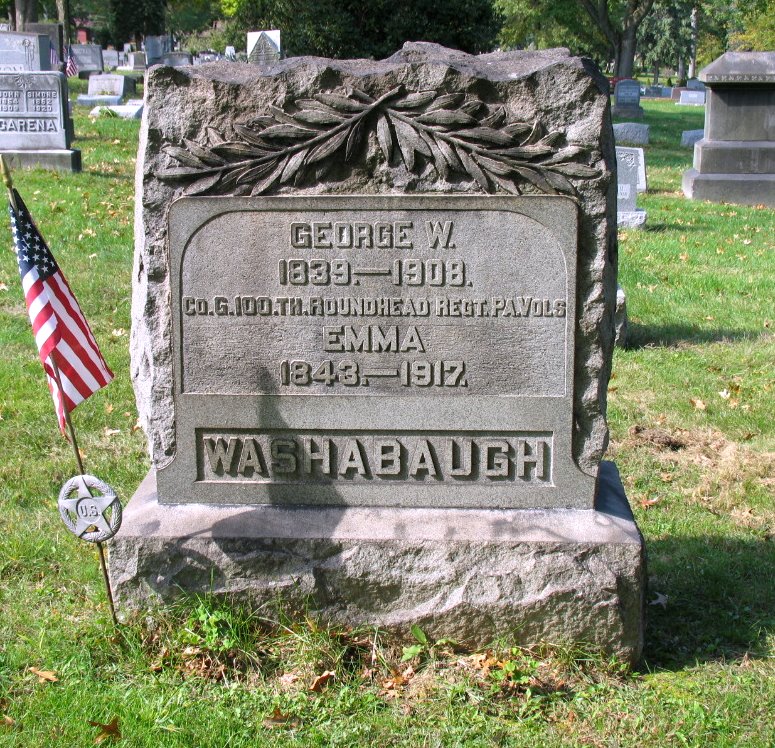
Military Monday: George Washabaugh, a wounded warrior!

George Washabaugh
1839-1908
Co. G.,100th "Roundhead" Regiment, PA. Volunteers.
Mr. Washabaugh is buried in West Newton Cemetery, Westmoreland County, PA.


George W. Washabaugh enlisted August 28, 1861.

"During his service he took part in an engagement of Hilton Head, S.C."
From there "he sailed board the Ocean Queen via Port Royal, Portal  entrance and Legareville, a journey of about three weeks, and from there he sailed to James Island, S.C., a journey of twenty miles, during which time the steamer was under almost continual fire from the enemy."
"At the battle of James Island, S.C., June 16,1862, Mr. Washabaugh was wounded by a portion of a shell which struck his head, and his regiment retreating , he was left lying on the field for dead,
and lay there unconscious for seven hours."
The wound caused left sided partial paralysis and "partial loss of the use of the use of his left arm.."
Being unable to return to service "he was mustered out October 16, 1862."
He was then appointed assistant provost marshal and later postmaster in Jackson Centre, Mercer County, PA. He resigned from that post to run a hotel in Grove City, PA. for 16 years. "While there he built a hotel known as "Washabaugh Hotel" "and later "known as the "Filer House"."
When he left Grove City he moved to Suterville, Pa in 1883 and bought a grist mill , sold later to Taylor and Boggs. "In 1885 he was elected burgess of West Newton, PA" and then elected justice of the peace.
He served as the commander of J.C. Markle Post, No. 57, G.A.R., at West Newton for two years. He, also, taught Sabbath school at his local church.
He was the son of David and Sarah (Huey) Washabaugh.

A very inspirational story. Mr. Washabsaugh  was mustered out in October of 1862. On June 22, 1863 married Marie E. Arnold, daughter Aaron Arnold, a local preacher, and had two children. He continued working and improving his and his families life even with a partially paralyzed left side.
A "Wounded Warrior" from the Civil War.

Don't forget to thank a soldier for their service to our country and it's people.

Information taken from: Biographical And Historical Cyclopedia of Westmoreland County Pennsylvania. Printed 1890
Posted by Picasa

Tuesday, November 8, 2011

Tombstone Tuesday: George Rinsel

Z6ZGT255H885

In memory of 
George Rinsel
Died
March 6, 1845 in 
the 54th year of his life


It took over 165 years for Georges stone to deteriorate but thanks to digital photographs he may be remembered for much longer.


George Rinsel is buried in St. Vincents Cemetery, Latrobe Pa.


Sunday, October 2, 2011

Matrilineal line

In response to Randy at Genea-musing my mother's line:
(My mitocondrial DNA line:)
1) Neva Waltonbaugh 1929
2) Neva Davis (Davies) 1909
3) Neva Cochenour 1880
4) Catherine Frew 1862
5) Eliza Duff (McElduff) 1831-34? *(see our RIP blog on finally finding her headstone!)
6) Margaret Myers ?
And here this line ends.
It is a different perspective doing it this way.
I have not had a DNA test done but plan to do so.
(Hint: we found many of my female ancestors looking for and finding the males.)
On my mom's side many lines go back to the 1600's 'domestically'!
We're working on finding and verifying.
Right now we're concentrating on verifying back to Revolutionary War Patriots.
Thanks for the challenge though, it opened up my genealogy in a different light and , also, renewed my desire to find Margaret Myers and verify her and find her family history.
JLK/NK56

Saturday, September 17, 2011

Surname Saturday: Finding Frews

As I have gotten older I tend to procrastinate but when I get started I can go 'full tilt boogie'.
We have only been able to look for family grave monuments on weekends. I took the phone number of a much visited cemetery with me one day this week and made a personal call on the road. We have been unable to find one of my direct ancestors graves. I was somewhat certain she was in  this cemetery but after finding so many of my family here but not her or her married name we began to question if my memory of my trips here with my grandmother as a child had been correct.
In speaking with a lovely lady at the office I was verified that she was in the cemetery and given her exact lot number. Luckily  we were able to visit within a day or two. I went to the office, spoke to the same lovey lady and obtained a map with a star at her general spot and the names on the stones surrounding her. We drove to the section as I eagerly anticipated this discovery. When we arrived there wasn't a second row of stones immediately behind the first but a long row of beautiful rhododendrons in all their adult and healthy splendor. We pulled the car over to an appropriate spot and started to walk to the first row.
Yes, we found the name of the stone directly in front of my Eliza. But no second row! We walked over toward the beautiful bushes. Gently pulling apart the branches we saw several stones inside the surrounding bushes and surrounded by several branches were large jewel weeds one could not see from the road, they blended in so well.  I had to walk around to the less dense side of the bush to sneak into the group of bushes. It felt like being a kid again playing making a cabin under a bush just under a group of trees. My husband being much taller was able to bend around some branches and see into the greenery. He hollered, " it's Eliza."
We gently removed all the dead branches and moved the branches we were able to without any kind of tools or hurting the plants. We, also, removed the 'passed their prime' and dying jewel weeds so you could see the one facet of the monolith without trimming the rhododendrons.


Her stone was larger than I thought it would be. A nice monolith. She had died before her husband and this was a lovely choice. He was a tailor and must have done well to purchase such a lovely stone.


Her inscription was not on the face or the back of the stone but on the side  facet. It indicated she was the wife of J.G. (I have his info as James G.) but his inscription is missing. The office had his name as being in this lot grave # 2.

No wonder we hadn't found her after so many attempts to find her! 

She was near the original entrance in one of the first areas of the cemetery. When I began to plot all my many relatives on the map I found Eliza was in the section next to her daughter and son-in-law who are with his parents. More relatives. As I continued I found for over 120 years my family has been burying members here  all in sections in a line from front to back of the cemetery. You could walk a straight line through these sections of this huge cemetery without getting worn out.

First of all it's so lovely to be able to get info from the office.
Second I told the lovely lady in the office this is a lovely very well taken care of cemetery. A very pleasant one to visit.
And last but not least I want to mention how great this staff member was at helping me.
This wonderful, beautifully maintained for over 160 years, cemetery is the West Newton cemetery and my experiences here have made me want to sale my plots and stones and buy ones in this one.


Saturday, September 10, 2011

Doing the 'Happy Dance'

We kept hitting a brick wall on my husband's fathers side of the family. Even with the internet and all the sites for family trees and document sites we just couldn't find his Dad's family to verify or disprove all the 'word of mouth' info we had..
His grandmother had several children with different 'husbands'. We found info on her family because she came from a large prominent family but her relationship with my husband's grandfather was not verified. We had documents of two of her children that noted him as the father using his last name but couldn't find him anywhere.
Rumor was he was 'from' Canada. Another barrier.
Finally we had a chance to travel near the area a marriage between them may be documented. We found a place to park very close to the courthouse, everyone was open and friendly to us. The registrars office was homey and welcome. Most of the computers were being used. Just a very good experience compared to others we've had.
Then we found his grandmother's name and started pulling up the documents. Whoa! We found a marriage application and marriage between his grand parents. So it did happen! We almost did the 'Genealogy Happy Dance' right there in that office.
We had heard vague good and bad things about his Dad's family. But now we know it wasn't because of an illegitimacy stigma.
When we got started looking at the application document we were in shock. Not only had they applied but the names of his grandfathers parents, their birthplace and that they were deceased at the time were noted. His grandfathers place of residence and his occupation were marked. Were these items fact? We would have to verify.
There were multiple 'eye openers' in the first few lines. The document was filled in by hand and being a copy was in places hard to decipher. They did not give access to the originals so we had to rely on the computer copies and the enlargement on screen.
Immediately we noted that three things on the left side of the document , the male applicant's side,  were not at all what we had heard. The surnames were not what we expected. His grandfather's name was either misunderstood by the person doing the documentation or just not what we had been told for years. Did his grandfather have an accent or was not fluent in English? Maybe French Canadian? Then in scrolling down we found my husband's surname was listed as his great-grandmother's maiden name. We were told at one time his father had a falling out with his dad and changed the spelling of his last name. The problem being the grandfather's name on the document is the last half of his mother's maiden name, the confusion gets more complicated and our happy dance moment is a whole new set of info to search for and verify.


My husband's surname is Kayhart. We were told his grandfathers name was Earl Kahart and that Earl's son added a y to his surname. What we think is  found is Earl K. Hart on this document.  J.K. Hart listed as Earl's father and possibly Mollie or Millie Kayhart on the mother site. Earl's place of birth is hard to read. But looking at the father's place of birth it  looks similar to it and more like Ontario!?  But are those words after each of these places  shorthand for Canada? The only possible C on the document to compare it to is on the females Dad's occupation. It  appears as though he was a carpenter. And what was Earl's occupation? Only more mysteries to unravel.
        What does it look like to you? 

Thursday, September 1, 2011

The destruction of Old Brush Creek Cemetery.

We were checking out old cemeteries that had a common family name, that occurred often in my family's past, listed as being interred there. We visited an old cemetery with many old stones.

At least 50% of the monuments in the cemetery were purposely knocked down.  
 The quote on this stone indicates it no longer matters to these departed souls. How apropos!


 This pile was at the back of the cemetery and an all too often site these days.
 The large clumps seen here are where one or more monument(s) are knocked down and strewn about making mowing and 'weed whacking' hard to do without causing equiptment and monument damage. Toward the front of the cemetery a  section of multiple rows are all strewn about making upkeep unsafe for equipment and the caretaker's walking. We'll return in the late winter, early spring when no plants are grown up to attempt to at least read some of those stones.


At the end of the cemetery I started to walk toward the front entrance and spotted these two old slate stones still upright with a white substance applied in a manner as to read the carvings. At first I thought some one wanted to record the info and that rain had caused the dripping patterns. But as I walked closer I realized it was not either of the two methods we've seen on occasion used for this purpose. I thought, 'No, that can't be spray paint..." but realized when I touched it that was exactly what it was. I should have understood because of the violent destruction we saw upon entering the site that spray painting wasn't out of the question. I just hadn't excepted the depth of the other destruction, so wasn't ready for another form.


Why? What pleasure or feelings of achievement could these two types of destruction give someone to do such a thing? And because some of the dislocated monoliths were quite large it must have been done by a group of people or someone armed with motorized equipment to do the destruction.
I know many people feel cemeteries are not where the deceased are and so are really useless to them but many family members honor their loved ones at these last resting sites. (I being one of the latter) The cemetery will most likely never be repaired and will become another discarded site because of the difficulty to maintain it with such recklessness strewn about. It saddens me that this kind of destruction is pleasant to someone.
Can someone help me understand this blatant disrespect? It has no redeeming value. It's not art, not self-expression...to me serves no purpose. 

Monday, August 22, 2011

Finding Your Ancestors using GPS

Yesterday we took an early trek up north to find the cemeteries where my husbands grandmother, grandfather and great-grand father are buried. We hit a gold mine. But that's not what I'm blogging/posting about.
On our way home we left the GPS on and noticed green patches on the screen. You could tell by the road configuration whether these green sites were parks or cemeteries. We decided to stop at one cemetery and check out the names with a drive through for later exploration. On our way out I saw a name from my families past. It ends up there are several stones for this family there.
So you can use the GPS screen just to find unexpected info or to find a cemetery you have vague directions to.
Just a tip for others if they could use it. Happy Hunting family tree genealogists!
JLK/NK56

Sunday, August 14, 2011

Sunday's Obituary: Mrs. Emma J. Hawk

Finding the obituary of a Great, Greataunt, can be very rewarding to verify what you know and also open up many more branches to your family tree. Finding information on females can be daunting and obituaries can be very informative, unlike the census records they are found on before they are married. 
In this case I found her married name and her surviving children and brothers and also the married name of a surviving sister.
One curious thing is that she died at her daughters home, who has the same married name of Hawk.


New Castle New, Thursday, November 9, 1944, Page 2, Col.3

Sunday, August 7, 2011

Sunday's Obituary: Captain C. F. Mitchell

Captain C. F. Mitchell
Greensburg, Pa., January 24.- Captain Chauncey F. Mitchell, Greensburg's oldest citizen, who on last Tuesday celebrated the ninety-third anniversary of his birth, died at 4 O'clock yesterday afternoon in a chair at the home of Mr. and Mrs. Jacob Wineman. Captain Mitchell had not been ill and his death was unexpected. Captain Mitchell was born in a log cabin in Greensburg, January 17, 1818 and except two years spent in the west and 30 years in Somerset, always had lived here. Printer, newspaperman, soldier, and adventurer, Captain Mitchell led a life full of activity. When a boy he took up the printer's trade in the office of Murcury News in Pittsburg, now the Post. The old Ben Franklin press was operated by hand. This was in 1831. In 1854 the young man had risen to the position of editor and established the Somerset Democrat in Somerset, Pa. which he edited until 1861. He then enlisted in Company A, Pennsylvania Reserves, and went to the front. He served for three years in the army and took part in the battles of Antietam, Fredericksburg, Seven Days' Battle in the Wilderness and others. The last battle he fought was at Gettysburg. He was also a "forty-niner" having left with a large number of Westmorelanders for the gold fields of the Pacific coast. Six grown children survive Captain Mitchell, one of whom is Walter Mitchell, cashier of the Mellon National Bank of Pittsburg.


The Pittsburgh Press- Jan 24 1911
Page 17 column 4


Saturday, July 2, 2011

Lt. Col. Pomeroy, more info on a revolutionary patriot!

When we first saw the Lt. Colonel's gravestone we smiled and chuckled at the 'Indian killer' reference.  But having lived here in one of the first thriving states in the colonies and being hungry for that time period's history we know a little bit about this areas 'indian' attacks.


To give you a quick overview... first of all most of the people that came to the Quaker State (PA) came for the religious freedom and the ability to make it on their own and possibly own land. As Philadelphia grew and more people moved west the exposure to the native American nomads grew.
Understanding that this is a broad overview here it is: Most natives viewed this great, vast land as a gift of abundance to be utilized and taken care of for all people. They fought with other native tribes to retain the ability to utilize this mother earth. So there was violence among the natives long before the white man came.
During the French and Indian War and following through the Revolutionary War, many of the Indian raids that killed settlers were brought about by the instigation and collaboration of the French or British commanders.
The attack on the Westmoreland Co. seat of Hannah's town July 13, 1782 was just that. Working with the British, about 60 Canadian Rangers and  100 Seneca Indians fighting; under Guyasuta, attacked the small fort during the Revolutionary War. A young girl died trying to protect a child. (to see more about the death of Margaret, Peggy, Shaw and the Hannah's town raid see "Hannah's Town" a book  by local historians Helen Smith and George Swetnam, written in 1973 during Hannastown excavation. "ISBN 0-913228-06-0".) This was part of a multi-day raid on this area. Most attacks occurred during the summer because of the harsh winters and tracks in the snow led to the culprits. See, also,   http://www.starofthewest.org/hannastown/index.cfm

At that time settlers carried rifles to work their fields and always feared attack from the stealth natives. The Revolutionary War was fought on all fronts including in the backyards of the settlers, who were defending their family(s). Every few miles a family would be the voluntary "block parents" or block house, a safe haven during raids. My ancestors being inhabitants of this area had one such block house not far from where I've lived most of my life.

Pomeroy was one of the magistrates of Westmoreland Co. and  established the county seat at "Newtown", now Greensburg, PA.

His older brother, Thomas Pomeroy is said to have been the first white child born in Lancaster Co, a county between Philly and the Westmoreland co. area . Thomas left early July 21, 1763, to hunt for food for his wife and two children only to return to find a band of Indians had killed and scalped his wife and children. A women named Mrs. Johnson survived the attack. She "had an broken arm, her skull fractured and the scalp torn off her head." From History of the Cumberland County, Counties of Franklin and Cumberland Co.

So one can understand why after surviving the French and Indian War and having been commander of Fort Ligonier in 1777 ( taken from the French in the war)   he could have become "popularly known as the Indian killer". As commander he may have been labeled for actions at that time.

Fort Ligonier on Forbe's Trail, was the only major fort  on the way to Fort Pitt. (Fort Pitt was, also, originally French and known as Fort Duquesne.) Pitt gave  access to the very important Ohio river and thus access north to Canada and south to the mouth of the Mississippi.) Lewis and Clark had a their keel-boat built here before their trip west and of course George Washington was frequently in the area.
 Ligonier was just west of the difficult to navigate Allegheny Mountains at the gateway to the rolling hills of southwestern PA and in the area of many killings of settlers. To go west settlers had to pass through this  glacial gorge so it was the hub of much activity.


People didn't have the communications we have today so many of the natives and settlers only understood that the others had to be 'stopped'. This was self preservation on all sides.

All this history found from researching the inscription on an interesting grave marker.

Other sources: Old Westmoreland, the History of Western Pennsylvania during the Revolution. by Edgar W. Hassler. Fort Ligonier Museum site.   http://fortligonier.org/
 

Tuesday, June 21, 2011

Update; Rufus Davidson C.S.A.

On a previous post about Rufus Davidson (Confederate soldier buried in Westmoreland County Pa.) I stated that he was with the 2nd Maryland Cav. and wondered why he was buried here. And now a little bit more to the story.


While searching newspaper archives on Google News Archives http://genealogy.about.com/gi/o.htm?zi=1/XJ&zTi=1&sdn=genealogy&cdn=parenting&tm=3&f=11&su=p284.9.336.ip_p504.1.336.ip_&tt=2&bt=0&bts=0&zu=http%3A//news.google.com/archivesearch  I came across a story written in the Greensburg Daily Tribune dated April 6 1920 called Veteran,

Veteran Has Had Rough Winter
Rufus Cassius Davidson, lone Confederate veteran living in this section, is slowly recovering from injuries he sustained last fall when his faithful and trusted old horse kicked him in the ribs, landing a cork of the shoe on the spot where a Yankee bullet, in the battle of the Wilderness more than fifty years ago, found lodgement. Then the old horse squeezed his master against the side of the manger and would have killed the veteran if help had not arrived. The flu, too, attacked the hardy veteran and confined him to his home in Orchard avenue most of the winter. Slowly recuperating the former member of Stonewall Jackson's and later of Early's cavalry, stimulated by balmy spring weather, has been able to walk about the streets in his section of the town during the past week.
      A Daily Tribune reporter recently had a most interesting chat with tho Confederate veteran. " Yes, I had a mighty close call and I put in my toughest winter, but I am slowly coming back and I expect to work my garden lots again this summer" the veteran said. comrade Davidson belongs to Captain George A. Cribbs G.A.R. post and was particularly distress at the death of his personal friend Col. James Reed, for many years, one of the most prominent men in Westmoreland county G.A.R. circles.
     During the chat with veteran Comrade Davidson said he served two years and six months in the Second Maryland Cavalry under General Early. This regiment did much raiding to harass the Union army as well as to get foods. "ah yes, I well remember our regiment riding into Fredericktown in "That cool September morn which the poet Whittier so prettly described, when the boys caught sight of Barbara Fritchie waving 'Old Glory', a beautiful American flag from an upstairs window in her home. Up went rifles to shoot the flag from the woman's hands, When Barbara shouted, 'Shoot if you must, this old grayhead, but spare your country's flag, she said'."
     This defiant challenge from the gray haired patriot touched Stonewall Jackson, who thought that if conditions were reversed, hundreds of Southern women would unfurl the 'Stars and Bars' in the faces of Yankee soldiers in perfect safety and he ordered his men to "March On."
     Comrade Davidson is a native of Washington, D.C., and he was driven to enlist in the Southern army when a lad sixteen years old through police persecution in the Capital city. He served two years and six months and participated in many of the big battles that were fought on Virginia soil including Gettysburg. He says the cavalry to which he belonged had a most wholesome respect for General Phillip Sheridan.
     Comrade Davidson has been a resident or Greensburg for thirty years. He always marches with the members of Captain George A. Cribbs G.A.R. post in this city on Memorial and other G.A.R. occasions. One son, Mack, is a member of the Field Artillery branch of the army and he is doing duty down on the Mexican border.

Link to story;
http://news.google.com/newspapers?id=OEFXAAAAIBAJ&sjid=7kMNAAAAIBAJ&dq=rufus-davidson&pg=4871%2C2327859
If link doesn't work copy and paste to your browser

I find it very interesting that he participated with the G.A.R. and I bet that they had some great conversations among themselves about the war.
This story is even more interesting to me because he lived just a short distance from my home and his wife later died just a few houses away.
Rufus was born abt 1845 and died before 1931 when his wife Anna E. Davidson died. Both are buried in the Union cemetery, Greensburg, Pa.