Showing posts with label Cemeteries. Show all posts

Friday, January 31, 2014

Some One Asked: Why'd You Get Into Genealogy?

Well, for me it was two separate things that got me started. 

First a  binder of papers families had filled out and returned to one of my grandmother's brothers had my great grandparents and three of their children buried in three different cemeteries.
I wanted to find them for my grandmother before she passed away. 
I started checking out the cemeteries when I went by. One in particular had lost it's records to a chapel fire so I had to hoof it all over the cemetery! 
They, of course, were in one of the last sections I could look in and all together. 
I'm not sure if it was this excitement I had at finding them or his finding Find a Grave first but my husband and I started looking for my ancestors at a Quaker cemetery. 
 This quest for my relatives and the ability to fill requests for FAG fueled a common love for genealogy between us. 
I do confess though, I know I was driven by an underlying motive. Years ago my Grandmother had said the girls in our family could be DARS, Daughters of the American Revolution. Both she and my Mom wanted to do the process but never got to it.


I was told it was through a particular person so I began searching for this person only to find, eventually, this was not the correct person but that they had identified him by his given and middle name. I needed to find an ancestor with a different last name. 
Holy cow, there were so many people with this name in my family...and to confuse me more I had two different lines that followed a Robert to James to Finley generational progression that I kept getting confused. 
When you find one wonderful, hard to find answer it always leads to a dozen more questions.
We have been doing our genealogy for years now and know it will never be done...but it sure is fun doing the research and filling in the blanks.

What got you started in genealogy? 

Friday, January 17, 2014

Finding my lost uncle

How I found my lost uncle.

Growing up I always heard that my grandmother had 11 children, but try as I might I can only come up with seven aunts and uncles and my mother. Growing up it seems that the adults never really wanted to talk to you about it, they would say "grandma had 11 children and three died young", but never saying who, when, where or why.
Now that I am searching my ancestry and doing genealogy I decided that I would get the answer to this. After searching all available census records I went to the cemetery where a good portion of the family are buried including my grandmother and grandfather. When talking to the caretaker in the office I did get a tip that there was a child by the name of Milan Dokmanovic buried in the family plot. He was buried there April 2, 1926 but there was no other information available and prior to that the records had been destroyed in a fire in the early 1920s.

My next step was to go to Pennsylvania vital statistics and locate a death certificate for Milan. You can locate and send for Pennsylvania death certificates that are over 50 years old (1906-1964) at the Pennsylvania Dept. of Health website. After searching in the year for 1926 I located his state file number and used the form from the state to send for the record, the records cost five dollars a piece and you can order five of them at a time.
After about three weeks I received the copy in the mail.


Now I have a record of another one of my grandmother's children, number 9 with still 2 more to go.
Milan Dokmanovic, born July 1, 1923, died April 1, 1926, two years nine months old. This is why he did not appear on any Federal census'. Milan is buried in Mount Pleasant Cemetery presumably next to his mother and father in the family plot.


Next I will begin the task of searching the Pennsylvania death records between years of 1906 and 1925 to see if I can find anymore Dokmanovic surnames. Some years are alphabetized very nicely with the D's all in order, but with some years Da might be followed by Di then Du then back to Da.
Finding these records in genealogical research can be bittersweet. At first you are happy you've finally found that much sought after info but then very sad imagining how distraught my grandparents would have been watching this active two year old go from his active self to an extremely ill child and then dying. 
Having a grandchild at this age makes it vividly evident to us. 


Monday, July 22, 2013

Tombstone Tuesday:

Walking through Saint Vincent's Cemetery looking for monuments to fulfill photo requests we came upon this stone. No other stones close and no clue as to where J. F & E. F. BRIDGE are buried is seen.
Now I can hardly image having 12 children let alone losing 12 children. 


J.F. & E. F. BRIDGE lost just that many in a span of 28 years.
The deaths of these children started in 1862 with a one year old child dying. In 1865 two children, a 9 and a 7 year old were gone. A 19 year gap is broken by the 1884 deaths of four children. Four children in one year. They were a 7 year old, an 8 year old, a 9 year old and a 10 year old.  I checked for epidemics in the 1800's none are listed for 1884 all though TB, Malaria or Scarlet fever could happen at any time none were listed as significant that year.
By now the Bridges had lost 6 children between 10 and 1 year(s) of age at the time of their deaths.
A reprieve for 6 years allowed the rest of the family to continue to age.
But then came 1890 and the death of 5 more of the children.
An 8, a 10, a 12 a 19 and a 20 year old all died in 1890. 
Can you even imagine going through that after a gap of 6 years to recover from the loss of the last 4 deaths?
There was a flu epidemic in 1889 and one of Diphtheria in 1890 that continued through until 1895. Typhoid Fever was a problem in these years, also.
The couple continued to have new births through out this time with the last birth of the expired children in 1882.
How many children did this family have? Did any make it through adulthood to have their own families?
One of my ancestors had 16 children and 1 died in infancy, two I don't know their death dates yet. Another ancestor had 14 children and 3 died before adulthood. In all my genealogical research I've never seen this many from one immediate family.  I do know there is a story that my family had a history of herbalists to treat patients and mid wife. The chemicals/medications we currently used had their start from natural items.
We know childhood diseases were more prevalent before chemotherapeutic treatments were discovered and used. Penicillin was first used in 1942 for soldiers.No matter the problems and controversies over immunizations they have decreased childhood deaths significantly.
I understand families lost babies and it was an expected loss but I can't fathom the devastation of  losing 12 children.
Please, comment if you know of other diseases of these years. I'd like to know more!
Thanks for reading our post.
Have a good healthy day!

Monday, July 15, 2013

Update on: Its not always what it seems or it pays to dig deeper...


The day my husband found this marker at West Newton Cemetery he called me and together we did the "Happy Dance"!  On it is my 3rd great grandfather and grandmother, and my 2nd great grandfather and grandmother.

 I was always told our path to DAR was through Simon McGrew. It is actually through Simon McGrew Cochenour and then his mother Elizabeth Mains then on through Mains until we find Robert Means, our Patriot.


By looking at the stone,  it is relatively new and in great shape. So we thought that some one had placed a new stone on the family plot to replace an old weathered most likely unreadable stone(s) of those buried there. But that's not what this story is about. If you've followed our blogs on R.I.P. you know we did the "Happy Dance" when we found my third Great-Grandmother's, Eliza Duff Frew, marker in the Laurel bushes.    
http://restinginwestmoreland.blogspot.com/2011/09/surname-saturday-finding-frews.html


We had done so much research and got to the point we needed to meet with a family member that has collected all the family data and pictures of our family on my mom's side. So we  visited with the family member to compare notes. We told her we found Eliza Frew, mother of Catherine (Frew) Cochenour, on the pictured stone. She was of the opinion that one of Eliza's great grandchildren (a Davis baby) was buried with her! So off to the cemetery we go.


Going through the old cemetery books with the most helpful caretaker we realized there were 17 people in three different plots.

First at checking Eliza's and her husband J G Frew's site we found 3 adults and two babies interred there. . But the babies were the Frew's two infants  not their great grand child. (We hadn't known about them) The third adult was their married daughter, Olive Caddis. We know in the 1880 census Olive and her three children were living with her parents. Where is Mr. Caddis, Olive's husband? To top that off, the monument only had Eliza Frew's info engraved on it. It had three blank sides. Is this monument for all 5 of them?Or is the blank, weathered and sugared marble monolith beside her's the babies? Olive's? More questions.

So to the next plot we go: the Cochenour's.(as shown in the first picture) We find out there are actually two separate groups of burial's.

One belonged to Catherine Frew Cochenour, Eliza's daughter. 
In The Catherine (Frew) and Simon McGrew Cochenour lots were two adults and 6 babies! Three of these babies are their grandchildren, by their daughter Neva Pearl (Cochenour) Davis, the three Davis babies are Robert, Brynley and Chester Davis.. There were 3 other babies:  George W. Cochenour (baby), Kate Cochenour  (baby) and a baby boy Yukanalis ??. Two were children of Catherine and Simon we never heard of before now and one listed as baby Yukanalis! Who was this? There hasn't been anyone by that name in all of our genealogy research!

In the adjoining lot, the second group of burials: 
I was surprised to find out that Daniel Cochenour and Elizabeth (Mains) Cochenour where buried  with a baby Cochenour  and a Mrs.Kelly ??. Who is Mrs. Kelly?


 If you've been doing your genealogy, as you have come upon much sought information, and done that 'happy dance", you will usually find the very best info almost always comes with more questions that lead to more paths of info to pursue. We now have more questions than we started with at the beginning of this quest. So keep in mind in your genealogical research things may not always be as they appear.

Thank you for reading our blog. See you next time!

Update on baby Yukanalis!
Went to our family reunion this weekend and got new info on the baby with Catherine (Frew) & Simon McGrew Cochenour.
The baby was a child of Alice Cochenour & Thomas Paul Yuknalis.
They, too, are buried in West Newton Cemetery.
We have looked but have not found the names of her parents and exactly how she is related to Catherine Cochenour.
So another mystery solved but more questions.
We'll keep on looking for the answers...
Again thank you for visiting our blog. And don't underestimate all kinds of sources for genealogy research. Happy hunting!

Monday, March 12, 2012

Military Monday: Jacob R.Zuck

Jacob R. Zuck  1843-1915

"Jacob R. Zuck was a leading book and stationer of Mt.Pleasant and one who fought under the "Stars and Stripes" in the dark days of the rebellion. Jacob was born in Mt.Pleasant, Westmoreland County, Pa., Christmas 1843 and is a son of Samuel and Susan (Keister) Zuck."
At eighteen years of age he left the schoolroom for the tented field, having enlisted Oct. 5, 1861 in Co. B.28th Regt. Pa. Vol. He served in the army of northern Virginia and was later transfered to the army of the Potomac. Jacob was severely wounded at the battle of Antietam and honorably discharged Jan. 1863 on account of disability.
"On May 1, 1867, he was united in marriage to Emma Smitley and to their union have born two sons: Edwin born March 8, 1871, and Orray, born july 29, 1875."
In 1871 he became a member of the National Guards of Pennsylvania and was elected captain of the Mt.Pleasant rifles or Independent  company, seventeenth division. He was a member of  Robert Worden Post, No. 163, Grand Army of the Republic and was its commander in 1888.
Jacob is buried in Mt.Pleasant Cemetery, Mt. Pleasant, Pa.


Sources: Biographical And Historical Cyclopedia of Westmoreland County Pennsylvania. Printed 1890
Bates, Samuel P. History of the Pennsylvania Volunteers, 1861-65, Harrisburg, 1868-1871


Sunday, March 4, 2012

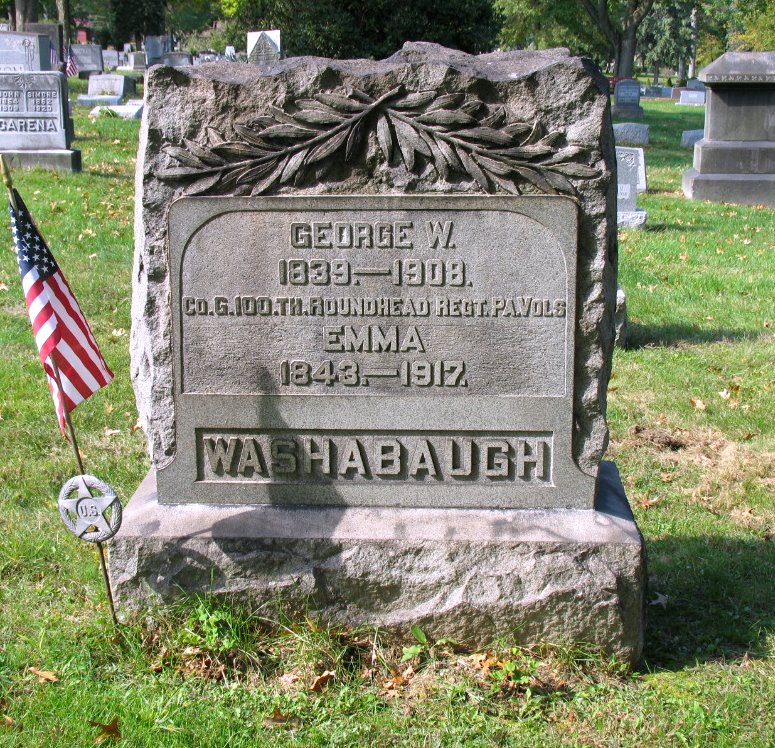
Military Monday: George Washabaugh, a wounded warrior!

George Washabaugh
1839-1908
Co. G.,100th "Roundhead" Regiment, PA. Volunteers.
Mr. Washabaugh is buried in West Newton Cemetery, Westmoreland County, PA.


George W. Washabaugh enlisted August 28, 1861.

"During his service he took part in an engagement of Hilton Head, S.C."
From there "he sailed board the Ocean Queen via Port Royal, Portal  entrance and Legareville, a journey of about three weeks, and from there he sailed to James Island, S.C., a journey of twenty miles, during which time the steamer was under almost continual fire from the enemy."
"At the battle of James Island, S.C., June 16,1862, Mr. Washabaugh was wounded by a portion of a shell which struck his head, and his regiment retreating , he was left lying on the field for dead,
and lay there unconscious for seven hours."
The wound caused left sided partial paralysis and "partial loss of the use of the use of his left arm.."
Being unable to return to service "he was mustered out October 16, 1862."
He was then appointed assistant provost marshal and later postmaster in Jackson Centre, Mercer County, PA. He resigned from that post to run a hotel in Grove City, PA. for 16 years. "While there he built a hotel known as "Washabaugh Hotel" "and later "known as the "Filer House"."
When he left Grove City he moved to Suterville, Pa in 1883 and bought a grist mill , sold later to Taylor and Boggs. "In 1885 he was elected burgess of West Newton, PA" and then elected justice of the peace.
He served as the commander of J.C. Markle Post, No. 57, G.A.R., at West Newton for two years. He, also, taught Sabbath school at his local church.
He was the son of David and Sarah (Huey) Washabaugh.

A very inspirational story. Mr. Washabsaugh  was mustered out in October of 1862. On June 22, 1863 married Marie E. Arnold, daughter Aaron Arnold, a local preacher, and had two children. He continued working and improving his and his families life even with a partially paralyzed left side.
A "Wounded Warrior" from the Civil War.

Don't forget to thank a soldier for their service to our country and it's people.

Information taken from: Biographical And Historical Cyclopedia of Westmoreland County Pennsylvania. Printed 1890
Posted by Picasa

Tuesday, November 8, 2011

Tombstone Tuesday: George Rinsel

Z6ZGT255H885

In memory of 
George Rinsel
Died
March 6, 1845 in 
the 54th year of his life


It took over 165 years for Georges stone to deteriorate but thanks to digital photographs he may be remembered for much longer.


George Rinsel is buried in St. Vincents Cemetery, Latrobe Pa.


Saturday, September 17, 2011

Surname Saturday: Finding Frews

As I have gotten older I tend to procrastinate but when I get started I can go 'full tilt boogie'.
We have only been able to look for family grave monuments on weekends. I took the phone number of a much visited cemetery with me one day this week and made a personal call on the road. We have been unable to find one of my direct ancestors graves. I was somewhat certain she was in  this cemetery but after finding so many of my family here but not her or her married name we began to question if my memory of my trips here with my grandmother as a child had been correct.
In speaking with a lovely lady at the office I was verified that she was in the cemetery and given her exact lot number. Luckily  we were able to visit within a day or two. I went to the office, spoke to the same lovey lady and obtained a map with a star at her general spot and the names on the stones surrounding her. We drove to the section as I eagerly anticipated this discovery. When we arrived there wasn't a second row of stones immediately behind the first but a long row of beautiful rhododendrons in all their adult and healthy splendor. We pulled the car over to an appropriate spot and started to walk to the first row.
Yes, we found the name of the stone directly in front of my Eliza. But no second row! We walked over toward the beautiful bushes. Gently pulling apart the branches we saw several stones inside the surrounding bushes and surrounded by several branches were large jewel weeds one could not see from the road, they blended in so well.  I had to walk around to the less dense side of the bush to sneak into the group of bushes. It felt like being a kid again playing making a cabin under a bush just under a group of trees. My husband being much taller was able to bend around some branches and see into the greenery. He hollered, " it's Eliza."
We gently removed all the dead branches and moved the branches we were able to without any kind of tools or hurting the plants. We, also, removed the 'passed their prime' and dying jewel weeds so you could see the one facet of the monolith without trimming the rhododendrons.


Her stone was larger than I thought it would be. A nice monolith. She had died before her husband and this was a lovely choice. He was a tailor and must have done well to purchase such a lovely stone.


Her inscription was not on the face or the back of the stone but on the side  facet. It indicated she was the wife of J.G. (I have his info as James G.) but his inscription is missing. The office had his name as being in this lot grave # 2.

No wonder we hadn't found her after so many attempts to find her! 

She was near the original entrance in one of the first areas of the cemetery. When I began to plot all my many relatives on the map I found Eliza was in the section next to her daughter and son-in-law who are with his parents. More relatives. As I continued I found for over 120 years my family has been burying members here  all in sections in a line from front to back of the cemetery. You could walk a straight line through these sections of this huge cemetery without getting worn out.

First of all it's so lovely to be able to get info from the office.
Second I told the lovely lady in the office this is a lovely very well taken care of cemetery. A very pleasant one to visit.
And last but not least I want to mention how great this staff member was at helping me.
This wonderful, beautifully maintained for over 160 years, cemetery is the West Newton cemetery and my experiences here have made me want to sale my plots and stones and buy ones in this one.


Thursday, September 1, 2011

The destruction of Old Brush Creek Cemetery.

We were checking out old cemeteries that had a common family name, that occurred often in my family's past, listed as being interred there. We visited an old cemetery with many old stones.

At least 50% of the monuments in the cemetery were purposely knocked down.  
 The quote on this stone indicates it no longer matters to these departed souls. How apropos!


 This pile was at the back of the cemetery and an all too often site these days.
 The large clumps seen here are where one or more monument(s) are knocked down and strewn about making mowing and 'weed whacking' hard to do without causing equiptment and monument damage. Toward the front of the cemetery a  section of multiple rows are all strewn about making upkeep unsafe for equipment and the caretaker's walking. We'll return in the late winter, early spring when no plants are grown up to attempt to at least read some of those stones.


At the end of the cemetery I started to walk toward the front entrance and spotted these two old slate stones still upright with a white substance applied in a manner as to read the carvings. At first I thought some one wanted to record the info and that rain had caused the dripping patterns. But as I walked closer I realized it was not either of the two methods we've seen on occasion used for this purpose. I thought, 'No, that can't be spray paint..." but realized when I touched it that was exactly what it was. I should have understood because of the violent destruction we saw upon entering the site that spray painting wasn't out of the question. I just hadn't excepted the depth of the other destruction, so wasn't ready for another form.


Why? What pleasure or feelings of achievement could these two types of destruction give someone to do such a thing? And because some of the dislocated monoliths were quite large it must have been done by a group of people or someone armed with motorized equipment to do the destruction.
I know many people feel cemeteries are not where the deceased are and so are really useless to them but many family members honor their loved ones at these last resting sites. (I being one of the latter) The cemetery will most likely never be repaired and will become another discarded site because of the difficulty to maintain it with such recklessness strewn about. It saddens me that this kind of destruction is pleasant to someone.
Can someone help me understand this blatant disrespect? It has no redeeming value. It's not art, not self-expression...to me serves no purpose. 

Monday, August 22, 2011

Finding Your Ancestors using GPS

Yesterday we took an early trek up north to find the cemeteries where my husbands grandmother, grandfather and great-grand father are buried. We hit a gold mine. But that's not what I'm blogging/posting about.
On our way home we left the GPS on and noticed green patches on the screen. You could tell by the road configuration whether these green sites were parks or cemeteries. We decided to stop at one cemetery and check out the names with a drive through for later exploration. On our way out I saw a name from my families past. It ends up there are several stones for this family there.
So you can use the GPS screen just to find unexpected info or to find a cemetery you have vague directions to.
Just a tip for others if they could use it. Happy Hunting family tree genealogists!
JLK/NK56

Thursday, August 11, 2011

Word Wrap 19th Century Style

Susana Eliza Fry


Susana : Eliza Fry.
Died March .3 . 1842
Agd' 10 Mon.ts

Ridge Churches Union Cemeteries, 
Trauger,
Westmoreland County, Pa


Monday, August 8, 2011

Tombstone Tuesday: John W. Fox

What does this monument represent? Do the different aspects of the stone indicate this man's profession, his group affiliations, his religious beliefs???


In driving through this cemetery one notices there are a lot of monuments with this cylinder on top but none are with the scalloped edges. My first impression was they looked like some type of roter. Was he a machinist late in life? Do the plaques for the stats indicate something specific about him? The stone, also, has four steps on each of the sides. Was he an architect, a draftsman, a builder or hoping to get to the stairway to heaven? And why does the monument have two sides for names but only has one side is etched. Did he have another person that was to be buried with him and didn't make it or never got the stone done after the interment?
This stone is one of the large stones in the cemetery and is in a section of other large stones. It's unique so most likely custom for his wants. There are a lot of other Fox stones in this cemetery and are clustered together as seen with families. This man is not with any other Foxes.
We did some research on this man and found that at one time he's listed as working at a stone quarry. Ok, so that would be were he became familiar with types of stones used in monuments? Maybe. Maybe he picked the actual stone to be used at work.
Another census has him working as a gardener. 
He is noted as being divorced in one census and the next a widower. One census has him head of house hold with his daughter living with him. 

Does anyone have a clue as to what the different aspects of this monument represent?  


Wednesday, August 3, 2011

Petting Parties?

Petting Parties? Problems in cemeteries 80 some years ago. 
Were a group of people gathered in the graveyard stroking their dogs and cats? LOL!
In papers today we see vandalizing and drinking in cemeteries. Back in the 1920's kids didn't have the availability of cars like today. Yet in this story some were misusing both cars and the cemetery. 
This was on the front page of the paper so important news at the time. Why else would the caretaker been given authority to arrest the petters?
Those familiar with the term 'petting' in my generation think of it done in the family car borrowed for a date or double date. "Parking!" 
In 1925 what would these petting parties have looked like? A bunch of kids sitting around the maintenance building/cottage 'making out' and getting to 'first base'? 
Don't you just love the flair these old newspaper stories are written with?
And what stories would we hear if cemetery monuments could talk! 

Greensburg Daily Tribune, Thursday July 9, 1925, Page 1.


Saturday, July 2, 2011

Lt. Col. Pomeroy, more info on a revolutionary patriot!

When we first saw the Lt. Colonel's gravestone we smiled and chuckled at the 'Indian killer' reference.  But having lived here in one of the first thriving states in the colonies and being hungry for that time period's history we know a little bit about this areas 'indian' attacks.


To give you a quick overview... first of all most of the people that came to the Quaker State (PA) came for the religious freedom and the ability to make it on their own and possibly own land. As Philadelphia grew and more people moved west the exposure to the native American nomads grew.
Understanding that this is a broad overview here it is: Most natives viewed this great, vast land as a gift of abundance to be utilized and taken care of for all people. They fought with other native tribes to retain the ability to utilize this mother earth. So there was violence among the natives long before the white man came.
During the French and Indian War and following through the Revolutionary War, many of the Indian raids that killed settlers were brought about by the instigation and collaboration of the French or British commanders.
The attack on the Westmoreland Co. seat of Hannah's town July 13, 1782 was just that. Working with the British, about 60 Canadian Rangers and  100 Seneca Indians fighting; under Guyasuta, attacked the small fort during the Revolutionary War. A young girl died trying to protect a child. (to see more about the death of Margaret, Peggy, Shaw and the Hannah's town raid see "Hannah's Town" a book  by local historians Helen Smith and George Swetnam, written in 1973 during Hannastown excavation. "ISBN 0-913228-06-0".) This was part of a multi-day raid on this area. Most attacks occurred during the summer because of the harsh winters and tracks in the snow led to the culprits. See, also,   http://www.starofthewest.org/hannastown/index.cfm

At that time settlers carried rifles to work their fields and always feared attack from the stealth natives. The Revolutionary War was fought on all fronts including in the backyards of the settlers, who were defending their family(s). Every few miles a family would be the voluntary "block parents" or block house, a safe haven during raids. My ancestors being inhabitants of this area had one such block house not far from where I've lived most of my life.

Pomeroy was one of the magistrates of Westmoreland Co. and  established the county seat at "Newtown", now Greensburg, PA.

His older brother, Thomas Pomeroy is said to have been the first white child born in Lancaster Co, a county between Philly and the Westmoreland co. area . Thomas left early July 21, 1763, to hunt for food for his wife and two children only to return to find a band of Indians had killed and scalped his wife and children. A women named Mrs. Johnson survived the attack. She "had an broken arm, her skull fractured and the scalp torn off her head." From History of the Cumberland County, Counties of Franklin and Cumberland Co.

So one can understand why after surviving the French and Indian War and having been commander of Fort Ligonier in 1777 ( taken from the French in the war)   he could have become "popularly known as the Indian killer". As commander he may have been labeled for actions at that time.

Fort Ligonier on Forbe's Trail, was the only major fort  on the way to Fort Pitt. (Fort Pitt was, also, originally French and known as Fort Duquesne.) Pitt gave  access to the very important Ohio river and thus access north to Canada and south to the mouth of the Mississippi.) Lewis and Clark had a their keel-boat built here before their trip west and of course George Washington was frequently in the area.
 Ligonier was just west of the difficult to navigate Allegheny Mountains at the gateway to the rolling hills of southwestern PA and in the area of many killings of settlers. To go west settlers had to pass through this  glacial gorge so it was the hub of much activity.


People didn't have the communications we have today so many of the natives and settlers only understood that the others had to be 'stopped'. This was self preservation on all sides.

All this history found from researching the inscription on an interesting grave marker.

Other sources: Old Westmoreland, the History of Western Pennsylvania during the Revolution. by Edgar W. Hassler. Fort Ligonier Museum site.   http://fortligonier.org/
 

Friday, July 1, 2011

Revolutionary War Veterans

As we celebrate our great nation's independence we would like to remember some of those who risked all and fought for that precious gift. 

The United States of America

 Here are a few of those soldiers buried in Old Salem Church Cemetery  in New Derry, Pennsylvania: 


IN memory of
Thomas Anderson
who departed this life
April 30th, 1828
aged 103 years.


John Barnett
1755-1825
served in the
 war of
the revolution.


In memory of
William Bell
who departed this life
Nov'r 21st 1828 in the 73rd
Year of his age.


Zebulon Doty
N.J.
state
troops
Rev. War
1758-1842.


IN
memory of
Uriah Matson
died June 6th, 1826 in
77 year of his age..


John Pomeroy
1745-1809
Revolutionary veteran
Lt. Col.of militia
Indian killer
Magistrate
m. Hannah Graham.
( More on Lt. Col. Pomeroy will follow in another post. ) 


Moses Stuert
born 1722
died July
28 1790.

To all those who fought for our freedoms let us remember them as we celebrate.
Thank you for our freedoms!

Tuesday, June 21, 2011

Update; Rufus Davidson C.S.A.

On a previous post about Rufus Davidson (Confederate soldier buried in Westmoreland County Pa.) I stated that he was with the 2nd Maryland Cav. and wondered why he was buried here. And now a little bit more to the story.


While searching newspaper archives on Google News Archives http://genealogy.about.com/gi/o.htm?zi=1/XJ&zTi=1&sdn=genealogy&cdn=parenting&tm=3&f=11&su=p284.9.336.ip_p504.1.336.ip_&tt=2&bt=0&bts=0&zu=http%3A//news.google.com/archivesearch  I came across a story written in the Greensburg Daily Tribune dated April 6 1920 called Veteran,

Veteran Has Had Rough Winter
Rufus Cassius Davidson, lone Confederate veteran living in this section, is slowly recovering from injuries he sustained last fall when his faithful and trusted old horse kicked him in the ribs, landing a cork of the shoe on the spot where a Yankee bullet, in the battle of the Wilderness more than fifty years ago, found lodgement. Then the old horse squeezed his master against the side of the manger and would have killed the veteran if help had not arrived. The flu, too, attacked the hardy veteran and confined him to his home in Orchard avenue most of the winter. Slowly recuperating the former member of Stonewall Jackson's and later of Early's cavalry, stimulated by balmy spring weather, has been able to walk about the streets in his section of the town during the past week.
      A Daily Tribune reporter recently had a most interesting chat with tho Confederate veteran. " Yes, I had a mighty close call and I put in my toughest winter, but I am slowly coming back and I expect to work my garden lots again this summer" the veteran said. comrade Davidson belongs to Captain George A. Cribbs G.A.R. post and was particularly distress at the death of his personal friend Col. James Reed, for many years, one of the most prominent men in Westmoreland county G.A.R. circles.
     During the chat with veteran Comrade Davidson said he served two years and six months in the Second Maryland Cavalry under General Early. This regiment did much raiding to harass the Union army as well as to get foods. "ah yes, I well remember our regiment riding into Fredericktown in "That cool September morn which the poet Whittier so prettly described, when the boys caught sight of Barbara Fritchie waving 'Old Glory', a beautiful American flag from an upstairs window in her home. Up went rifles to shoot the flag from the woman's hands, When Barbara shouted, 'Shoot if you must, this old grayhead, but spare your country's flag, she said'."
     This defiant challenge from the gray haired patriot touched Stonewall Jackson, who thought that if conditions were reversed, hundreds of Southern women would unfurl the 'Stars and Bars' in the faces of Yankee soldiers in perfect safety and he ordered his men to "March On."
     Comrade Davidson is a native of Washington, D.C., and he was driven to enlist in the Southern army when a lad sixteen years old through police persecution in the Capital city. He served two years and six months and participated in many of the big battles that were fought on Virginia soil including Gettysburg. He says the cavalry to which he belonged had a most wholesome respect for General Phillip Sheridan.
     Comrade Davidson has been a resident or Greensburg for thirty years. He always marches with the members of Captain George A. Cribbs G.A.R. post in this city on Memorial and other G.A.R. occasions. One son, Mack, is a member of the Field Artillery branch of the army and he is doing duty down on the Mexican border.

Link to story;
http://news.google.com/newspapers?id=OEFXAAAAIBAJ&sjid=7kMNAAAAIBAJ&dq=rufus-davidson&pg=4871%2C2327859
If link doesn't work copy and paste to your browser

I find it very interesting that he participated with the G.A.R. and I bet that they had some great conversations among themselves about the war.
This story is even more interesting to me because he lived just a short distance from my home and his wife later died just a few houses away.
Rufus was born abt 1845 and died before 1931 when his wife Anna E. Davidson died. Both are buried in the Union cemetery, Greensburg, Pa.

Wednesday, June 8, 2011

Tuesday, June 7, 2011

Review of "the Generations Project" on BYUtv

In our spare time we catch an episode or two of "The Generations  Project". Ours being a site regarding those Resting In Pennsylvania we noticed almost every episode, if not every one, has a walk through a cemetery looking for ancestors grave stones.
This show has ordinary people looking into their family tree, for a multiple of reasons. It follows through to various sources and means to find their quest. Similar to "Who Do You Think You Are?" it moves through the process of the search, revealing good and bad answers. It shows how the quest changes the person seeking their family history. These individuals are not famous and therefore we 'ordinary folk' can more readily identify with their situations. We recommend this show to anyone interested in their or other's history.
You can find it at:
http://www.byutv.org/show/1791/

Sunday, April 17, 2011

Sentimental Sunday; Visiting Graves

After four months I finally was able to visit my mom's grave. We had the "grave side' services at the chapel in the cemetery because of a snow storm. It seems to always rain or snow for our family's graveside services. Mom was a very dedicated and productive soul. She went from high school into nursing school and worked at the same hospital her whole career. We were all born in that hospital and that's where she spent her last 3 days, surrounded by her loving family
Last Sunday we did a round of grave visits. Every stone, every grave tells a story. It's part of history. It's not macabre. I took pix with my android if I could just figure out how to put them on here...
'...as long as someone remembers you live forever...'.


Monday, March 28, 2011

Military Monday: Daniel Ashbaugh

Daniel Ashbaugh
Private Co E. 11th Pa Infantry


Daniel Ashbaugh
Feb. 14, 1832
Aug 30, 1862

Daniel was mustered in at Westmoreland County Pa. on Oct. 4, 1861 and was killed on Aug. 30, 1862 at the 2nd battle of Bull Run.
Photo from Blairsville Cemetery, Blairsville, Pa.

The Pa 11th was nicknamed the "Bloody Eleventh" at the battle of Falling Water, July 21st 1861
A total of 1,890 men served in the regiment during the war, and only 340 men were discharged at wars end.