Showing posts with label Federal Census. Show all posts

Wednesday, October 30, 2013

The Great Flu Epidemic's Effect on Family Females!.


I've been thinking a lot lately about my Mom and her Mom's family. I knew my grandmother, Gan; as we called her, had been through the Great Flu Epidemic back in 1918.

I, also, knew her Dad, Sidney,  died October 27 of that year.
In researching the Great Flu Epidemic the statistics indicate October 27, 1918 was the day the largest number of people died as a result of the flu epidemic in one day.


Sidney Davis Gravestone

In retrospect I always found myself thinking how the death of my great-grandfather effected the women in his life.
I know my great-grandfather's death left a widow (at 38 y.o.) with 11 children, having already lost two of them. She had lost a son, Brynley, in 1907 at the tender age of three and an infant not quite two months old in 1914. 
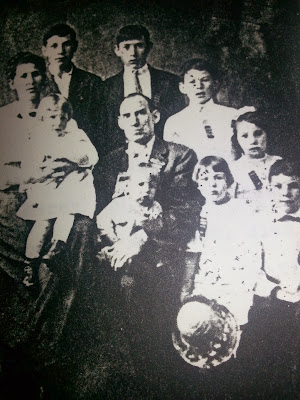
Picture of Sidney Davis and Family

Sidney Davis family in 1913 at Kennywood Park, Pittsburgh, PA 

Now she was left a widow with a 21 year old WWI soldier son, a 20 year old son, a 17 year old son, a 15 year old son, a 12 year old daughter, a 10 year old daughter, an 8 year old daughter, a 6 year old son, a three year old son, a 22 month old daughter and a 9 day old son.
She had her hands full and she was on her own. Her parents and both sets of grand-parents were deceased. What a struggle her and her children's lives must have been. She was thrust into a life without an income. Her perfectly healthy working husband got the Spanish flu and died! How many of the children that lived through the flu epidemic were sick? Did  she suffer the flu herself? I'm sure some of the children old enough to work helped out financially and the older girls helped with youngest children but I can't fathom how she did it. How many were still in school? How many could actually find employment and help with the finances? There was no pension, no social security benefits for her underage children, how did she make ends meet? I know my Mom always told me she came from strong pioneer stock, maybe that was it. My great-grandmother's family had been here for almost 200 years at the time of the Great Flu Epidemic.

Sidney's mom, Mary, had just lost her husband of 49 years, William, 9 months ago. Mary, still grieving her husbands loss, loses  her 44 year old son, with 11 children.  She was dealt another blow by her first son's death at 49 years seventeen days later on November 13, 1918. At the age of  70 years she was living under the roof of two of her coal miner sons, a pregnant daughter-in-law and two grandchildren. Mary will go on to lose a 39 year old daughter, Ida, with  in a year. Ida leaving  3 of her children, girls  ages 12 years to  17 years old motherless and fatherless and her three children from her second marriage with out a mom. (The oldest being 6 years of age and the youngest being 17 months old.) Did the three older girls live with their step dad and their 3 other siblings and help raise them after Mom died? (I know Ida was a milliner and a seamstress so with her death they had less income. )
The oldest girl became a nurse and I don't know if she ever married. The 5 year old was hit by a train at 10 years of age and died. The rest of the kids went on to marry and have their own families.

That brings up the sisters of Sidney: Edith and Ida lost their dear brother. (Ida dies in October 3, 1919)

Next comes the daughters: Margaret, Kathryn, Neva and Marie lost their Dad. How emotionally and financially devistating would that be? They had been the first in their town to have a telephone in their home, now luxuries like that would be unattainable. 
None of the children were married yet so when the widow became a grandmother the grandchildren knew no grandfather.

 Back in 1918 life was hard. In looking at census records you can see a definative pattern of babies showing up on the scene within a year or two of marraige and then about every two years.
Yes, many didn't make it to adulthood but that the doesn't belittle the loss. Losing a viable productive husband with 11 children ages 9 days to 21 years of age had to be mind numbing, but 'pick yourself up and get on with it' would be the only choice the working class family had back then...
I
honor all those who did so.

Thank you for reading our story. Feel free to add anything or ask anything.

Monday, July 15, 2013

Update on: Its not always what it seems or it pays to dig deeper...


The day my husband found this marker at West Newton Cemetery he called me and together we did the "Happy Dance"!  On it is my 3rd great grandfather and grandmother, and my 2nd great grandfather and grandmother.

 I was always told our path to DAR was through Simon McGrew. It is actually through Simon McGrew Cochenour and then his mother Elizabeth Mains then on through Mains until we find Robert Means, our Patriot.


By looking at the stone,  it is relatively new and in great shape. So we thought that some one had placed a new stone on the family plot to replace an old weathered most likely unreadable stone(s) of those buried there. But that's not what this story is about. If you've followed our blogs on R.I.P. you know we did the "Happy Dance" when we found my third Great-Grandmother's, Eliza Duff Frew, marker in the Laurel bushes.    
http://restinginwestmoreland.blogspot.com/2011/09/surname-saturday-finding-frews.html


We had done so much research and got to the point we needed to meet with a family member that has collected all the family data and pictures of our family on my mom's side. So we  visited with the family member to compare notes. We told her we found Eliza Frew, mother of Catherine (Frew) Cochenour, on the pictured stone. She was of the opinion that one of Eliza's great grandchildren (a Davis baby) was buried with her! So off to the cemetery we go.


Going through the old cemetery books with the most helpful caretaker we realized there were 17 people in three different plots.

First at checking Eliza's and her husband J G Frew's site we found 3 adults and two babies interred there. . But the babies were the Frew's two infants  not their great grand child. (We hadn't known about them) The third adult was their married daughter, Olive Caddis. We know in the 1880 census Olive and her three children were living with her parents. Where is Mr. Caddis, Olive's husband? To top that off, the monument only had Eliza Frew's info engraved on it. It had three blank sides. Is this monument for all 5 of them?Or is the blank, weathered and sugared marble monolith beside her's the babies? Olive's? More questions.

So to the next plot we go: the Cochenour's.(as shown in the first picture) We find out there are actually two separate groups of burial's.

One belonged to Catherine Frew Cochenour, Eliza's daughter. 
In The Catherine (Frew) and Simon McGrew Cochenour lots were two adults and 6 babies! Three of these babies are their grandchildren, by their daughter Neva Pearl (Cochenour) Davis, the three Davis babies are Robert, Brynley and Chester Davis.. There were 3 other babies:  George W. Cochenour (baby), Kate Cochenour  (baby) and a baby boy Yukanalis ??. Two were children of Catherine and Simon we never heard of before now and one listed as baby Yukanalis! Who was this? There hasn't been anyone by that name in all of our genealogy research!

In the adjoining lot, the second group of burials: 
I was surprised to find out that Daniel Cochenour and Elizabeth (Mains) Cochenour where buried  with a baby Cochenour  and a Mrs.Kelly ??. Who is Mrs. Kelly?


 If you've been doing your genealogy, as you have come upon much sought information, and done that 'happy dance", you will usually find the very best info almost always comes with more questions that lead to more paths of info to pursue. We now have more questions than we started with at the beginning of this quest. So keep in mind in your genealogical research things may not always be as they appear.

Thank you for reading our blog. See you next time!

Update on baby Yukanalis!
Went to our family reunion this weekend and got new info on the baby with Catherine (Frew) & Simon McGrew Cochenour.
The baby was a child of Alice Cochenour & Thomas Paul Yuknalis.
They, too, are buried in West Newton Cemetery.
We have looked but have not found the names of her parents and exactly how she is related to Catherine Cochenour.
So another mystery solved but more questions.
We'll keep on looking for the answers...
Again thank you for visiting our blog. And don't underestimate all kinds of sources for genealogy research. Happy hunting!

Monday, June 10, 2013

How the Textile Arts and the Census are Connected!

HI!

I find this info would be relevent to both our 'RIP' readers regarding how info recording has evolved and for the connection the the 1880 and 1890 census tabulation and to my fellow crafters and weavers as to the connection of weaving to the evolution of recording and storing data. Thank you, Coverlet Gallery for your FB message.

I got this info from the Coverlet Gallery in Latrobe,PA


Jacquard Loom: The Precursor Computer

The computer and textile industries, to most people, seem to have nothing in common. If anything, people can easily comprehend that development in the computer industry led to advancement in the textile industry. How hard would it be to believe that the exact opposite is also correct? Yes, it is quite true that the weaving and textile industry greatly influenced the development of modern technology. How is this possible? The answers can be found in analyzing how exactly a Jacquard loom works.
In “Punch Cards: 19th Century Coverlet Technology,” we discussed the mechanics of the Jacquard loom. The basic concept is this: each hook in the loom attempts to push the warp to the opposite side of the weft; this is either permitted or prevented depending on the punch card. The warp is pushed when that location corresponds to a hole in the punch card. Essentially, the punch card holds a pre-set pattern that is read by the loom and serves to guide the loom.
The idea of there being recorded information read by a machine was quickly borrowed to be applied to mathematical computation, when Charles Babbage (mathematician, engineer, inventor) attempted to build a calculating machine. His first attempt failed in 1832, when the British government ended all funding for the building of the “Difference Engine.” The Difference Engine was supposed to be able to make calculations based off of a table of numbers. After ten years of building and no further funding, Babbage’s invention was never finished.
In an attempt to develop a better plan to construct a calculator, he implemented this idea of using the punch card as stored data. His new machine would be programmable, and would “read” a set of punch cards, each with a pattern of holes that represented an abstract idea, such as a set of raw data. He liked the idea of the punch cards because they could be read by a machine and could be used to store computed numbers for future reference. This new invention was to be called the “Analytical Engine.”
Analytic Engine
Charles Babbage’s “General Plan” for his Analytical Engine
The Analytical Engine was supposed to have two main parts: the store (which holds numbers), and the mill (which used the numbers to compute new results). This notion can easily be compared to the modern-day computer, since in both the Analytical Engine and the modern computer, there are two main parts: one can store data/memory, and the other can compute/interpret this memory.
The concept of the Analytical Engine was a great improvement upon that of the Difference Engine. The British government, however, refused to see this, since they were still displeased that they provided 10 years of funding to Babbage’s unfruitful attempt to build his first invention. They denied him the funding that he required, and he attempted to build this machine himself, until he died in 1871 with two incomplete inventions.
It is unfortunate that Babbage was unable to see his inventions through; his ideas were so far ahead of his time that the technology with which he was working was not advanced enough to be used in any of his inventions, leaving him to develop many of the pieces of machinery himself.
It was not until about ten years later that such an idea was actually created. Herman Hollerith was hired as a U.S. Census worker in 1881, and saw many of the difficulties in tabulating the data. The U.S. population had increased by approx. 30% in the previous ten years, making the calculation much longer and tedious than in the past; in fact, it took the U.S. Census Bureau over 7 years to calculate the data from 1880. Hollerith began to develop a machine that would make such calculations easier, so that any increase in the U.S. population would not pose such issues as seen in the 1880’s. Hollerith created the Hollerith Desk, a machine using a gear-driven mechanism that could count by sensing holes within the punch cards that were entered into the machine. Behind the machine was a wall of indicators (similar to a car’s speedometer) that displayed the results of the collected data.
Hollerith Desk
Hollerith Desk
Hollerith’s innovative machine served well for the 1890 Census, for it allowed the calculations to be completed in a record 3 years and saved approximately $5 million in the process. With this machine, Hollerith founded the Tabulating Machine Company, now known as International Business Machines (IBM). Hollerith’s punch-card driven tabulating machines could only count data at first. However, by the 1928, his machines could add and subtract by using the new and improved “IBM Computer Card.”
1890 Census Punched Card
Advances in the technology of IBM’s tabulating machines led to the development of the early computer, which all used punch cards (similarly to IBM’s tabulating machines) and a magnetic memory drum. Such advances included the key punch machine (similar to a typewriter) that entered the data onto the punch card.
The punch card was the primary method by which IBM stored data until the 1970’s when scientists had discovered other means by which to store data. The develop and widespread use of magnetic tape greatly decreased the need for punch cards, since magnetic tape is much more cost and space efficient. Some punch card machines are still used today: tollbooths, voting machines, etc.
This amazing transition of machinery illustrates the importance of punch card technology to the modern world. The invention that has prevailed over two centuries “was not invented by IBM in 1928. Nor was it invented by Herman Hollerith in the late 19th century.” Charles Babbage also utilized, but did not create the punch card. The foundation of all the ensuing technology was Jacquard’s loom created in 1801 which revolutionized the textile industry and created, what is more or less, the equivalent of 18th century graphic design.                                                                                                      This is their site address:   https://www.facebook.com/#!/pages/The-Foster-and-Muriel-McCarl-Coverlet-Gallery/112183105458886?hc_location=stream