Showing posts with label Records. Show all posts

Friday, April 11, 2014

The Pennsylvania Quaker Split

I did not know this!

I had enjoyed the pilot of the new series, Turn.
I was thinking about it while doing my usual perusal through our various online sites and decided to look up the names of the characters to keep them straight in my head. 
Well! I ended up looking up Anna Strong as the female spy and then ended up in Townsend's  history and some how found a connection to the Pennsylvanian Quakers.

It is noted that during the tension of our nations uprising some of the Quakers began siding with the colonists that felt they had rights to what they had worked for and the stirrings of patriotism along with Thomas Paine's writings caused a split between 'political Quakers' and 'religious Quakers".

Ok, so I've been diverted.
My attention has now been focused on my ancestors.
I could say some Quakers married into my family or my family married Quakers...

Way back in the beginning of my husband and my quest to find the Quaker cemetery and site of the Quaker meeting house built on a piece of ground donated by my ancestor we wondered why the religion was not continued down through the generations.
One of my ancestors felt so deeply about the religion they donated land for a meeting house but the names disappear form the meetings records after so long...
Why? 
I don't know. 
We have fractured off into so many different quests I haven't found all the info in my families history but am documenting as much info as I can. 

I have always loved history and have focused more closely on American history as I've progressed.
With this new info found about the Pennsylvanian Quaker split I have a new bit of insight into why some Quakers diverted to Patriots.
I knew Ben Franklin had started a Militia to protect Philadelphia because the Quakers were pacifists and Philly was a bedazzling jewel ready to be plucked!

 Not to mention I've still not found out why there is a GAR marker in the Quaker cemetery...
History is who we are!
Don't you just love it?


Monday, July 15, 2013

Update on: Its not always what it seems or it pays to dig deeper...


The day my husband found this marker at West Newton Cemetery he called me and together we did the "Happy Dance"!  On it is my 3rd great grandfather and grandmother, and my 2nd great grandfather and grandmother.

 I was always told our path to DAR was through Simon McGrew. It is actually through Simon McGrew Cochenour and then his mother Elizabeth Mains then on through Mains until we find Robert Means, our Patriot.


By looking at the stone,  it is relatively new and in great shape. So we thought that some one had placed a new stone on the family plot to replace an old weathered most likely unreadable stone(s) of those buried there. But that's not what this story is about. If you've followed our blogs on R.I.P. you know we did the "Happy Dance" when we found my third Great-Grandmother's, Eliza Duff Frew, marker in the Laurel bushes.    
http://restinginwestmoreland.blogspot.com/2011/09/surname-saturday-finding-frews.html


We had done so much research and got to the point we needed to meet with a family member that has collected all the family data and pictures of our family on my mom's side. So we  visited with the family member to compare notes. We told her we found Eliza Frew, mother of Catherine (Frew) Cochenour, on the pictured stone. She was of the opinion that one of Eliza's great grandchildren (a Davis baby) was buried with her! So off to the cemetery we go.


Going through the old cemetery books with the most helpful caretaker we realized there were 17 people in three different plots.

First at checking Eliza's and her husband J G Frew's site we found 3 adults and two babies interred there. . But the babies were the Frew's two infants  not their great grand child. (We hadn't known about them) The third adult was their married daughter, Olive Caddis. We know in the 1880 census Olive and her three children were living with her parents. Where is Mr. Caddis, Olive's husband? To top that off, the monument only had Eliza Frew's info engraved on it. It had three blank sides. Is this monument for all 5 of them?Or is the blank, weathered and sugared marble monolith beside her's the babies? Olive's? More questions.

So to the next plot we go: the Cochenour's.(as shown in the first picture) We find out there are actually two separate groups of burial's.

One belonged to Catherine Frew Cochenour, Eliza's daughter. 
In The Catherine (Frew) and Simon McGrew Cochenour lots were two adults and 6 babies! Three of these babies are their grandchildren, by their daughter Neva Pearl (Cochenour) Davis, the three Davis babies are Robert, Brynley and Chester Davis.. There were 3 other babies:  George W. Cochenour (baby), Kate Cochenour  (baby) and a baby boy Yukanalis ??. Two were children of Catherine and Simon we never heard of before now and one listed as baby Yukanalis! Who was this? There hasn't been anyone by that name in all of our genealogy research!

In the adjoining lot, the second group of burials: 
I was surprised to find out that Daniel Cochenour and Elizabeth (Mains) Cochenour where buried  with a baby Cochenour  and a Mrs.Kelly ??. Who is Mrs. Kelly?


 If you've been doing your genealogy, as you have come upon much sought information, and done that 'happy dance", you will usually find the very best info almost always comes with more questions that lead to more paths of info to pursue. We now have more questions than we started with at the beginning of this quest. So keep in mind in your genealogical research things may not always be as they appear.

Thank you for reading our blog. See you next time!

Update on baby Yukanalis!
Went to our family reunion this weekend and got new info on the baby with Catherine (Frew) & Simon McGrew Cochenour.
The baby was a child of Alice Cochenour & Thomas Paul Yuknalis.
They, too, are buried in West Newton Cemetery.
We have looked but have not found the names of her parents and exactly how she is related to Catherine Cochenour.
So another mystery solved but more questions.
We'll keep on looking for the answers...
Again thank you for visiting our blog. And don't underestimate all kinds of sources for genealogy research. Happy hunting!

Monday, June 10, 2013

How the Textile Arts and the Census are Connected!

HI!

I find this info would be relevent to both our 'RIP' readers regarding how info recording has evolved and for the connection the the 1880 and 1890 census tabulation and to my fellow crafters and weavers as to the connection of weaving to the evolution of recording and storing data. Thank you, Coverlet Gallery for your FB message.

I got this info from the Coverlet Gallery in Latrobe,PA


Jacquard Loom: The Precursor Computer

The computer and textile industries, to most people, seem to have nothing in common. If anything, people can easily comprehend that development in the computer industry led to advancement in the textile industry. How hard would it be to believe that the exact opposite is also correct? Yes, it is quite true that the weaving and textile industry greatly influenced the development of modern technology. How is this possible? The answers can be found in analyzing how exactly a Jacquard loom works.
In “Punch Cards: 19th Century Coverlet Technology,” we discussed the mechanics of the Jacquard loom. The basic concept is this: each hook in the loom attempts to push the warp to the opposite side of the weft; this is either permitted or prevented depending on the punch card. The warp is pushed when that location corresponds to a hole in the punch card. Essentially, the punch card holds a pre-set pattern that is read by the loom and serves to guide the loom.
The idea of there being recorded information read by a machine was quickly borrowed to be applied to mathematical computation, when Charles Babbage (mathematician, engineer, inventor) attempted to build a calculating machine. His first attempt failed in 1832, when the British government ended all funding for the building of the “Difference Engine.” The Difference Engine was supposed to be able to make calculations based off of a table of numbers. After ten years of building and no further funding, Babbage’s invention was never finished.
In an attempt to develop a better plan to construct a calculator, he implemented this idea of using the punch card as stored data. His new machine would be programmable, and would “read” a set of punch cards, each with a pattern of holes that represented an abstract idea, such as a set of raw data. He liked the idea of the punch cards because they could be read by a machine and could be used to store computed numbers for future reference. This new invention was to be called the “Analytical Engine.”
Analytic Engine
Charles Babbage’s “General Plan” for his Analytical Engine
The Analytical Engine was supposed to have two main parts: the store (which holds numbers), and the mill (which used the numbers to compute new results). This notion can easily be compared to the modern-day computer, since in both the Analytical Engine and the modern computer, there are two main parts: one can store data/memory, and the other can compute/interpret this memory.
The concept of the Analytical Engine was a great improvement upon that of the Difference Engine. The British government, however, refused to see this, since they were still displeased that they provided 10 years of funding to Babbage’s unfruitful attempt to build his first invention. They denied him the funding that he required, and he attempted to build this machine himself, until he died in 1871 with two incomplete inventions.
It is unfortunate that Babbage was unable to see his inventions through; his ideas were so far ahead of his time that the technology with which he was working was not advanced enough to be used in any of his inventions, leaving him to develop many of the pieces of machinery himself.
It was not until about ten years later that such an idea was actually created. Herman Hollerith was hired as a U.S. Census worker in 1881, and saw many of the difficulties in tabulating the data. The U.S. population had increased by approx. 30% in the previous ten years, making the calculation much longer and tedious than in the past; in fact, it took the U.S. Census Bureau over 7 years to calculate the data from 1880. Hollerith began to develop a machine that would make such calculations easier, so that any increase in the U.S. population would not pose such issues as seen in the 1880’s. Hollerith created the Hollerith Desk, a machine using a gear-driven mechanism that could count by sensing holes within the punch cards that were entered into the machine. Behind the machine was a wall of indicators (similar to a car’s speedometer) that displayed the results of the collected data.
Hollerith Desk
Hollerith Desk
Hollerith’s innovative machine served well for the 1890 Census, for it allowed the calculations to be completed in a record 3 years and saved approximately $5 million in the process. With this machine, Hollerith founded the Tabulating Machine Company, now known as International Business Machines (IBM). Hollerith’s punch-card driven tabulating machines could only count data at first. However, by the 1928, his machines could add and subtract by using the new and improved “IBM Computer Card.”
1890 Census Punched Card
Advances in the technology of IBM’s tabulating machines led to the development of the early computer, which all used punch cards (similarly to IBM’s tabulating machines) and a magnetic memory drum. Such advances included the key punch machine (similar to a typewriter) that entered the data onto the punch card.
The punch card was the primary method by which IBM stored data until the 1970’s when scientists had discovered other means by which to store data. The develop and widespread use of magnetic tape greatly decreased the need for punch cards, since magnetic tape is much more cost and space efficient. Some punch card machines are still used today: tollbooths, voting machines, etc.
This amazing transition of machinery illustrates the importance of punch card technology to the modern world. The invention that has prevailed over two centuries “was not invented by IBM in 1928. Nor was it invented by Herman Hollerith in the late 19th century.” Charles Babbage also utilized, but did not create the punch card. The foundation of all the ensuing technology was Jacquard’s loom created in 1801 which revolutionized the textile industry and created, what is more or less, the equivalent of 18th century graphic design.                                                                                                      This is their site address:   https://www.facebook.com/#!/pages/The-Foster-and-Muriel-McCarl-Coverlet-Gallery/112183105458886?hc_location=stream

Saturday, September 10, 2011

Doing the 'Happy Dance'

We kept hitting a brick wall on my husband's fathers side of the family. Even with the internet and all the sites for family trees and document sites we just couldn't find his Dad's family to verify or disprove all the 'word of mouth' info we had..
His grandmother had several children with different 'husbands'. We found info on her family because she came from a large prominent family but her relationship with my husband's grandfather was not verified. We had documents of two of her children that noted him as the father using his last name but couldn't find him anywhere.
Rumor was he was 'from' Canada. Another barrier.
Finally we had a chance to travel near the area a marriage between them may be documented. We found a place to park very close to the courthouse, everyone was open and friendly to us. The registrars office was homey and welcome. Most of the computers were being used. Just a very good experience compared to others we've had.
Then we found his grandmother's name and started pulling up the documents. Whoa! We found a marriage application and marriage between his grand parents. So it did happen! We almost did the 'Genealogy Happy Dance' right there in that office.
We had heard vague good and bad things about his Dad's family. But now we know it wasn't because of an illegitimacy stigma.
When we got started looking at the application document we were in shock. Not only had they applied but the names of his grandfathers parents, their birthplace and that they were deceased at the time were noted. His grandfathers place of residence and his occupation were marked. Were these items fact? We would have to verify.
There were multiple 'eye openers' in the first few lines. The document was filled in by hand and being a copy was in places hard to decipher. They did not give access to the originals so we had to rely on the computer copies and the enlargement on screen.
Immediately we noted that three things on the left side of the document , the male applicant's side,  were not at all what we had heard. The surnames were not what we expected. His grandfather's name was either misunderstood by the person doing the documentation or just not what we had been told for years. Did his grandfather have an accent or was not fluent in English? Maybe French Canadian? Then in scrolling down we found my husband's surname was listed as his great-grandmother's maiden name. We were told at one time his father had a falling out with his dad and changed the spelling of his last name. The problem being the grandfather's name on the document is the last half of his mother's maiden name, the confusion gets more complicated and our happy dance moment is a whole new set of info to search for and verify.


My husband's surname is Kayhart. We were told his grandfathers name was Earl Kahart and that Earl's son added a y to his surname. What we think is  found is Earl K. Hart on this document.  J.K. Hart listed as Earl's father and possibly Mollie or Millie Kayhart on the mother site. Earl's place of birth is hard to read. But looking at the father's place of birth it  looks similar to it and more like Ontario!?  But are those words after each of these places  shorthand for Canada? The only possible C on the document to compare it to is on the females Dad's occupation. It  appears as though he was a carpenter. And what was Earl's occupation? Only more mysteries to unravel.
        What does it look like to you? 

Sunday, August 14, 2011

Sunday's Obituary: Mrs. Emma J. Hawk

Finding the obituary of a Great, Greataunt, can be very rewarding to verify what you know and also open up many more branches to your family tree. Finding information on females can be daunting and obituaries can be very informative, unlike the census records they are found on before they are married. 
In this case I found her married name and her surviving children and brothers and also the married name of a surviving sister.
One curious thing is that she died at her daughters home, who has the same married name of Hawk.


New Castle New, Thursday, November 9, 1944, Page 2, Col.3

Saturday, July 2, 2011

Lt. Col. Pomeroy, more info on a revolutionary patriot!

When we first saw the Lt. Colonel's gravestone we smiled and chuckled at the 'Indian killer' reference.  But having lived here in one of the first thriving states in the colonies and being hungry for that time period's history we know a little bit about this areas 'indian' attacks.


To give you a quick overview... first of all most of the people that came to the Quaker State (PA) came for the religious freedom and the ability to make it on their own and possibly own land. As Philadelphia grew and more people moved west the exposure to the native American nomads grew.
Understanding that this is a broad overview here it is: Most natives viewed this great, vast land as a gift of abundance to be utilized and taken care of for all people. They fought with other native tribes to retain the ability to utilize this mother earth. So there was violence among the natives long before the white man came.
During the French and Indian War and following through the Revolutionary War, many of the Indian raids that killed settlers were brought about by the instigation and collaboration of the French or British commanders.
The attack on the Westmoreland Co. seat of Hannah's town July 13, 1782 was just that. Working with the British, about 60 Canadian Rangers and  100 Seneca Indians fighting; under Guyasuta, attacked the small fort during the Revolutionary War. A young girl died trying to protect a child. (to see more about the death of Margaret, Peggy, Shaw and the Hannah's town raid see "Hannah's Town" a book  by local historians Helen Smith and George Swetnam, written in 1973 during Hannastown excavation. "ISBN 0-913228-06-0".) This was part of a multi-day raid on this area. Most attacks occurred during the summer because of the harsh winters and tracks in the snow led to the culprits. See, also,   http://www.starofthewest.org/hannastown/index.cfm

At that time settlers carried rifles to work their fields and always feared attack from the stealth natives. The Revolutionary War was fought on all fronts including in the backyards of the settlers, who were defending their family(s). Every few miles a family would be the voluntary "block parents" or block house, a safe haven during raids. My ancestors being inhabitants of this area had one such block house not far from where I've lived most of my life.

Pomeroy was one of the magistrates of Westmoreland Co. and  established the county seat at "Newtown", now Greensburg, PA.

His older brother, Thomas Pomeroy is said to have been the first white child born in Lancaster Co, a county between Philly and the Westmoreland co. area . Thomas left early July 21, 1763, to hunt for food for his wife and two children only to return to find a band of Indians had killed and scalped his wife and children. A women named Mrs. Johnson survived the attack. She "had an broken arm, her skull fractured and the scalp torn off her head." From History of the Cumberland County, Counties of Franklin and Cumberland Co.

So one can understand why after surviving the French and Indian War and having been commander of Fort Ligonier in 1777 ( taken from the French in the war)   he could have become "popularly known as the Indian killer". As commander he may have been labeled for actions at that time.

Fort Ligonier on Forbe's Trail, was the only major fort  on the way to Fort Pitt. (Fort Pitt was, also, originally French and known as Fort Duquesne.) Pitt gave  access to the very important Ohio river and thus access north to Canada and south to the mouth of the Mississippi.) Lewis and Clark had a their keel-boat built here before their trip west and of course George Washington was frequently in the area.
 Ligonier was just west of the difficult to navigate Allegheny Mountains at the gateway to the rolling hills of southwestern PA and in the area of many killings of settlers. To go west settlers had to pass through this  glacial gorge so it was the hub of much activity.


People didn't have the communications we have today so many of the natives and settlers only understood that the others had to be 'stopped'. This was self preservation on all sides.

All this history found from researching the inscription on an interesting grave marker.

Other sources: Old Westmoreland, the History of Western Pennsylvania during the Revolution. by Edgar W. Hassler. Fort Ligonier Museum site.   http://fortligonier.org/
 

Sunday, March 27, 2011

Sundays Obituary; Albert H. Boyd


Obituary of Albert H. Boyd


Albert H. Boyd, 63, Kelly Station carpenter, died at 9:15 p.m. Wednesday in the Citizens General  hospital, New Kensington.
Death resulted from a complication of diseases. He had been in the hospital one week.
Mr. Boyd lived all his life in Kelly Station, Within a half-mile of where he was born.
Surviving are his wife, five children: Mrs. Floyd Conner, Warren, Ohio; Harry, Kittanning: Mrs. Audrey Bennett, Kittanning: Mrs. Geo. Nicholson, New Florence: Ernest, at home: four brothers: Eli, Ford City: Samuel, John and Frank, Kelly Station: three sisters, Mrs Jane Hawk, New Castle: Mrs. John Thompson, Kelly Station and Mrs. Sarah Hartman, Logansport, and 10 grandchildren.
Funeral services will be held at 2:30 p.m. tomorrow in the Bethel Lutheran church in charge of Rev. Walter Kennedy, pastor of the Tidal and Templeton Presbyterian churches, with burial in the adjoining cemetery.
Simpsons' Daily Leader-Times, Saturday, October 17, 1931, Page 5, Col. 5


Albert was my great-grandfather and his daughter, listed here as Mrs. Geo. Nicholson, my grandmother.
Sadly Alberts wife Catherine died just 6 weeks later on Dec.3, 1931
Albert's tombstone has his name as Alvin H. Boyd and on his obit it is Albert. Possibly he was known by different names by different family members.
Albert and Catherine are both buried in the Bethel Lutheran Church Cemetery in Ford City, Pa.


How often do you see a Presby minister doing services at another denominations church? Everyone working together back in the early-mid 1900's? Don't you love history?

Saturday, March 12, 2011

1910 FEDERAL CENSUS


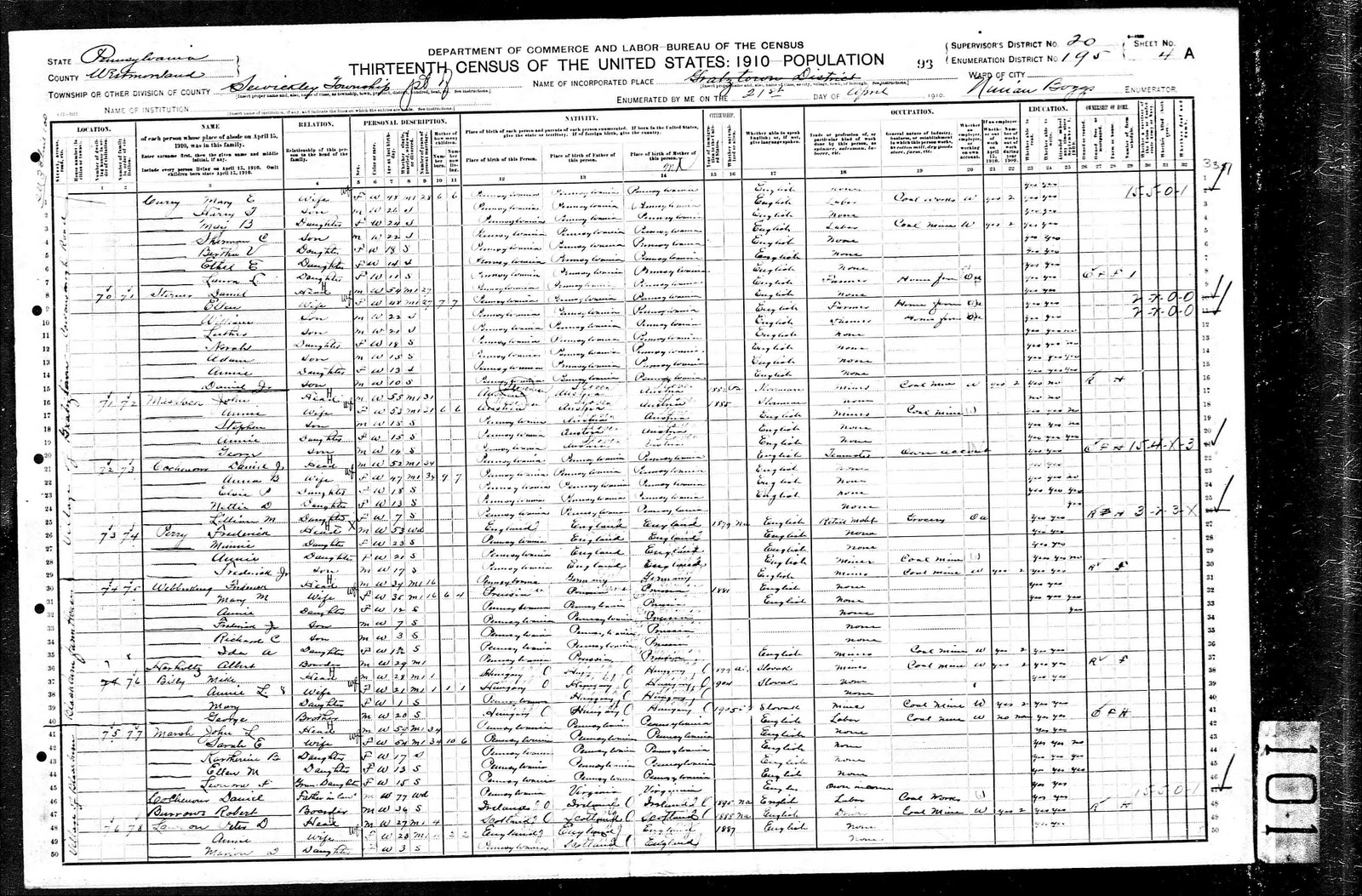
Have you heard stories about your grandmother having had babies that passed away but can't find any records of them?  When piecing together members of a family a great way to find children that may have been forgotten or overlooked is to  to use the 1910 Federal Census and tombstones. On the 1910 Federal Census line number 10 asks the female/wife how many children she gave birth to and line 11 asks how many are still alive. If in between census years the deceased children could get lost.


By using the 1910 federal census for location you can search local cemeteries. When finding the correct cemetery you may find a stone like this one. This could be a great clue to unknown aunts, uncles, or cousins. Many times these children are buried close to their parents. These children would not have been enumerated on any Federal Census.


 If your lucky you might hit the mother load and a lot more information, as on this headstone:


One thing to remember is that in some cemeteries small children are buried in their  own section. The reason for this, I suspect,  is the lots would probably cost less.