Showing posts with label Military. Show all posts

Tuesday, May 21, 2013

Tombstone Tuesday: The Little Heroine of Hannastown.


It was mid July in 1782. The new country was at war. The militia were fighting the British and the British hired Indians and Canadians to do raids on the families left behind. 
This was the frontier then. 
People would guard family members as they harvested their crops because the raids were frequent and on this day  people harvesting at the Huffnagle's farm noticed the Indians and they ran to the safety  of Hannastown and the fort.
On this particular day, July 13, many were still at a celebration of a wedding at the Miller's Farm the day before so most of those left behind were children, elderly and women. 
The Moses Shaw family were among those at Fort Hannastown when the Indians under Guyasuta and the Canadians arrived. The group burned the town down and fired on the fort.  As a toddler was crawling toward the stockade pickets and an opening in the wall  young Margaret "Peggy" Shaw ran for the child to pull it to safety and was shot in the breast piecing her lung. The child was safe. Peggy lingered for 14 days before dying. 
Peggy Shaw is buried in the Middle Presbyterian Graveyard in Mt. Pleasant, PA. 


Peggy was the daughter of Moses and Margaret (Patterson) Shaw.
Different accounts of the story have Peggy aged form 12 to 16 years old, none the less a heroine.

Monday, March 12, 2012

Military Monday: Jacob R.Zuck

Jacob R. Zuck  1843-1915

"Jacob R. Zuck was a leading book and stationer of Mt.Pleasant and one who fought under the "Stars and Stripes" in the dark days of the rebellion. Jacob was born in Mt.Pleasant, Westmoreland County, Pa., Christmas 1843 and is a son of Samuel and Susan (Keister) Zuck."
At eighteen years of age he left the schoolroom for the tented field, having enlisted Oct. 5, 1861 in Co. B.28th Regt. Pa. Vol. He served in the army of northern Virginia and was later transfered to the army of the Potomac. Jacob was severely wounded at the battle of Antietam and honorably discharged Jan. 1863 on account of disability.
"On May 1, 1867, he was united in marriage to Emma Smitley and to their union have born two sons: Edwin born March 8, 1871, and Orray, born july 29, 1875."
In 1871 he became a member of the National Guards of Pennsylvania and was elected captain of the Mt.Pleasant rifles or Independent  company, seventeenth division. He was a member of  Robert Worden Post, No. 163, Grand Army of the Republic and was its commander in 1888.
Jacob is buried in Mt.Pleasant Cemetery, Mt. Pleasant, Pa.


Sources: Biographical And Historical Cyclopedia of Westmoreland County Pennsylvania. Printed 1890
Bates, Samuel P. History of the Pennsylvania Volunteers, 1861-65, Harrisburg, 1868-1871


Sunday, March 4, 2012

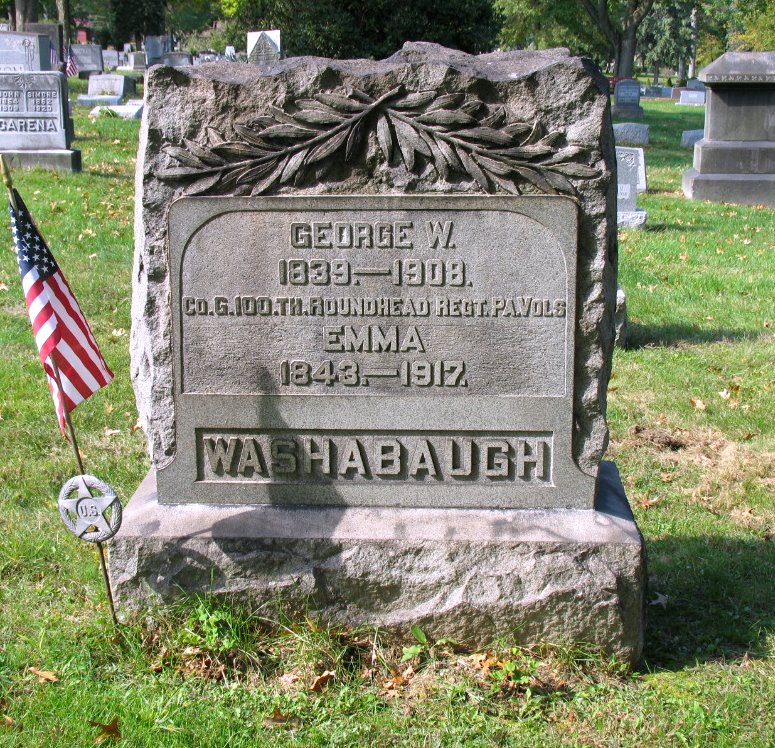
Military Monday: George Washabaugh, a wounded warrior!

George Washabaugh
1839-1908
Co. G.,100th "Roundhead" Regiment, PA. Volunteers.
Mr. Washabaugh is buried in West Newton Cemetery, Westmoreland County, PA.


George W. Washabaugh enlisted August 28, 1861.

"During his service he took part in an engagement of Hilton Head, S.C."
From there "he sailed board the Ocean Queen via Port Royal, Portal  entrance and Legareville, a journey of about three weeks, and from there he sailed to James Island, S.C., a journey of twenty miles, during which time the steamer was under almost continual fire from the enemy."
"At the battle of James Island, S.C., June 16,1862, Mr. Washabaugh was wounded by a portion of a shell which struck his head, and his regiment retreating , he was left lying on the field for dead,
and lay there unconscious for seven hours."
The wound caused left sided partial paralysis and "partial loss of the use of the use of his left arm.."
Being unable to return to service "he was mustered out October 16, 1862."
He was then appointed assistant provost marshal and later postmaster in Jackson Centre, Mercer County, PA. He resigned from that post to run a hotel in Grove City, PA. for 16 years. "While there he built a hotel known as "Washabaugh Hotel" "and later "known as the "Filer House"."
When he left Grove City he moved to Suterville, Pa in 1883 and bought a grist mill , sold later to Taylor and Boggs. "In 1885 he was elected burgess of West Newton, PA" and then elected justice of the peace.
He served as the commander of J.C. Markle Post, No. 57, G.A.R., at West Newton for two years. He, also, taught Sabbath school at his local church.
He was the son of David and Sarah (Huey) Washabaugh.

A very inspirational story. Mr. Washabsaugh  was mustered out in October of 1862. On June 22, 1863 married Marie E. Arnold, daughter Aaron Arnold, a local preacher, and had two children. He continued working and improving his and his families life even with a partially paralyzed left side.
A "Wounded Warrior" from the Civil War.

Don't forget to thank a soldier for their service to our country and it's people.

Information taken from: Biographical And Historical Cyclopedia of Westmoreland County Pennsylvania. Printed 1890
Posted by Picasa

Sunday, October 2, 2011

Whiskey Wars!

      I don't know if I've mentioned it before but early in our married life my spouse and I started a decades long ritual of reading to each other at bedtime. Lately we've been focusing on two old books about Pennsylvania we found going through 'stuff' at my mother's house.
     Just last night we read about the cantankerous Pennsylvanians demonstrating against the act of 1791 tax levy on distilled liquors. The Whiskey Insurrection was quite large here in old PA. Pennsylvania had recently ended long years of boundary wars with multiple countries and states. They had their "dander up".
     "A horse could carry only four bushels of grain across the Alleghenies from western Pennsylvania to eastern Pennsylvania, but could carry the product of 24 bushels in the form of whiskey. And on the return trip bring salt, sugar and iron. Distilling whiskey was a major industry. Western Pennsylvania contained more stills than any other area in the United States and therefore heavily taxed."
     This was the new government's first real test. The book tells "For three years Washington temporized with four Pennsylvania counties, because he feared that a call upon the militia to uphold the government would be repudiated, and that the Constitution, thus shown to have no hold upon the people's affections, would perish in mockery and derision.". George Washington and his Secretary of the Treasury Alexander Hamilton didn't intend to ignore any defiance against laws enacted by this new congress.
     A group of people calling themselves "Tom the Tinkers" went through the countryside intimidating people who paid the tax. They would smash or "mend" stills and leave intimidating notes posted on trees and posts. It was called "mending the still".
One law abiding citizen had  the Pittsburgh Gazette print the long, wordy diatribe the 'Tinkers' left him. Large numbers of people against the tax boycotted services of even clergy and physicians who were for obeying the law. Some houses were burned and militia sent to protect some of the officials.  I,also, read somewhere that a good 25% of the distilleries in the US were actually in western Pennsylvania..
     On August 1, 1794 a mass meeting of 7,000 armed insurgents was held at Braddock's Field. The president "himself led an army of 15,000 men as far as Bedford ...to suppress the disorder. Secretary Hamilton accompanied the troops to the scene of the disorder." People refusing to comply were arrested. Conferences between state and federal representatives restored law and order.  Men from both sides went on to be appointed and/or elected to political positions.
     There are 26 historical markers throughout southwestern Pennsylvania memorializing this Insurrection and the meetings and confrontations that occurred here. See this site for more information.
http://www.portal.state.pa.us/portal/server.pt/community/pennsylvania_historical_marker_program/2539/search_for_historical_markers/300886
quotes from: C.M. Bomberger; Twelfth Colony Plus. Jeannette Publishing Company, copyright 1934.

Sunday, August 7, 2011

Sunday's Obituary: Captain C. F. Mitchell

Captain C. F. Mitchell
Greensburg, Pa., January 24.- Captain Chauncey F. Mitchell, Greensburg's oldest citizen, who on last Tuesday celebrated the ninety-third anniversary of his birth, died at 4 O'clock yesterday afternoon in a chair at the home of Mr. and Mrs. Jacob Wineman. Captain Mitchell had not been ill and his death was unexpected. Captain Mitchell was born in a log cabin in Greensburg, January 17, 1818 and except two years spent in the west and 30 years in Somerset, always had lived here. Printer, newspaperman, soldier, and adventurer, Captain Mitchell led a life full of activity. When a boy he took up the printer's trade in the office of Murcury News in Pittsburg, now the Post. The old Ben Franklin press was operated by hand. This was in 1831. In 1854 the young man had risen to the position of editor and established the Somerset Democrat in Somerset, Pa. which he edited until 1861. He then enlisted in Company A, Pennsylvania Reserves, and went to the front. He served for three years in the army and took part in the battles of Antietam, Fredericksburg, Seven Days' Battle in the Wilderness and others. The last battle he fought was at Gettysburg. He was also a "forty-niner" having left with a large number of Westmorelanders for the gold fields of the Pacific coast. Six grown children survive Captain Mitchell, one of whom is Walter Mitchell, cashier of the Mellon National Bank of Pittsburg.


The Pittsburgh Press- Jan 24 1911
Page 17 column 4


Saturday, July 2, 2011

Lt. Col. Pomeroy, more info on a revolutionary patriot!

When we first saw the Lt. Colonel's gravestone we smiled and chuckled at the 'Indian killer' reference.  But having lived here in one of the first thriving states in the colonies and being hungry for that time period's history we know a little bit about this areas 'indian' attacks.


To give you a quick overview... first of all most of the people that came to the Quaker State (PA) came for the religious freedom and the ability to make it on their own and possibly own land. As Philadelphia grew and more people moved west the exposure to the native American nomads grew.
Understanding that this is a broad overview here it is: Most natives viewed this great, vast land as a gift of abundance to be utilized and taken care of for all people. They fought with other native tribes to retain the ability to utilize this mother earth. So there was violence among the natives long before the white man came.
During the French and Indian War and following through the Revolutionary War, many of the Indian raids that killed settlers were brought about by the instigation and collaboration of the French or British commanders.
The attack on the Westmoreland Co. seat of Hannah's town July 13, 1782 was just that. Working with the British, about 60 Canadian Rangers and  100 Seneca Indians fighting; under Guyasuta, attacked the small fort during the Revolutionary War. A young girl died trying to protect a child. (to see more about the death of Margaret, Peggy, Shaw and the Hannah's town raid see "Hannah's Town" a book  by local historians Helen Smith and George Swetnam, written in 1973 during Hannastown excavation. "ISBN 0-913228-06-0".) This was part of a multi-day raid on this area. Most attacks occurred during the summer because of the harsh winters and tracks in the snow led to the culprits. See, also,   http://www.starofthewest.org/hannastown/index.cfm

At that time settlers carried rifles to work their fields and always feared attack from the stealth natives. The Revolutionary War was fought on all fronts including in the backyards of the settlers, who were defending their family(s). Every few miles a family would be the voluntary "block parents" or block house, a safe haven during raids. My ancestors being inhabitants of this area had one such block house not far from where I've lived most of my life.

Pomeroy was one of the magistrates of Westmoreland Co. and  established the county seat at "Newtown", now Greensburg, PA.

His older brother, Thomas Pomeroy is said to have been the first white child born in Lancaster Co, a county between Philly and the Westmoreland co. area . Thomas left early July 21, 1763, to hunt for food for his wife and two children only to return to find a band of Indians had killed and scalped his wife and children. A women named Mrs. Johnson survived the attack. She "had an broken arm, her skull fractured and the scalp torn off her head." From History of the Cumberland County, Counties of Franklin and Cumberland Co.

So one can understand why after surviving the French and Indian War and having been commander of Fort Ligonier in 1777 ( taken from the French in the war)   he could have become "popularly known as the Indian killer". As commander he may have been labeled for actions at that time.

Fort Ligonier on Forbe's Trail, was the only major fort  on the way to Fort Pitt. (Fort Pitt was, also, originally French and known as Fort Duquesne.) Pitt gave  access to the very important Ohio river and thus access north to Canada and south to the mouth of the Mississippi.) Lewis and Clark had a their keel-boat built here before their trip west and of course George Washington was frequently in the area.
 Ligonier was just west of the difficult to navigate Allegheny Mountains at the gateway to the rolling hills of southwestern PA and in the area of many killings of settlers. To go west settlers had to pass through this  glacial gorge so it was the hub of much activity.


People didn't have the communications we have today so many of the natives and settlers only understood that the others had to be 'stopped'. This was self preservation on all sides.

All this history found from researching the inscription on an interesting grave marker.

Other sources: Old Westmoreland, the History of Western Pennsylvania during the Revolution. by Edgar W. Hassler. Fort Ligonier Museum site.   http://fortligonier.org/
 

Friday, July 1, 2011

Revolutionary War Veterans

As we celebrate our great nation's independence we would like to remember some of those who risked all and fought for that precious gift. 

The United States of America

 Here are a few of those soldiers buried in Old Salem Church Cemetery  in New Derry, Pennsylvania: 


IN memory of
Thomas Anderson
who departed this life
April 30th, 1828
aged 103 years.


John Barnett
1755-1825
served in the
 war of
the revolution.


In memory of
William Bell
who departed this life
Nov'r 21st 1828 in the 73rd
Year of his age.


Zebulon Doty
N.J.
state
troops
Rev. War
1758-1842.


IN
memory of
Uriah Matson
died June 6th, 1826 in
77 year of his age..


John Pomeroy
1745-1809
Revolutionary veteran
Lt. Col.of militia
Indian killer
Magistrate
m. Hannah Graham.
( More on Lt. Col. Pomeroy will follow in another post. ) 


Moses Stuert
born 1722
died July
28 1790.

To all those who fought for our freedoms let us remember them as we celebrate.
Thank you for our freedoms!

Tuesday, June 21, 2011

Update; Rufus Davidson C.S.A.

On a previous post about Rufus Davidson (Confederate soldier buried in Westmoreland County Pa.) I stated that he was with the 2nd Maryland Cav. and wondered why he was buried here. And now a little bit more to the story.


While searching newspaper archives on Google News Archives http://genealogy.about.com/gi/o.htm?zi=1/XJ&zTi=1&sdn=genealogy&cdn=parenting&tm=3&f=11&su=p284.9.336.ip_p504.1.336.ip_&tt=2&bt=0&bts=0&zu=http%3A//news.google.com/archivesearch  I came across a story written in the Greensburg Daily Tribune dated April 6 1920 called Veteran,

Veteran Has Had Rough Winter
Rufus Cassius Davidson, lone Confederate veteran living in this section, is slowly recovering from injuries he sustained last fall when his faithful and trusted old horse kicked him in the ribs, landing a cork of the shoe on the spot where a Yankee bullet, in the battle of the Wilderness more than fifty years ago, found lodgement. Then the old horse squeezed his master against the side of the manger and would have killed the veteran if help had not arrived. The flu, too, attacked the hardy veteran and confined him to his home in Orchard avenue most of the winter. Slowly recuperating the former member of Stonewall Jackson's and later of Early's cavalry, stimulated by balmy spring weather, has been able to walk about the streets in his section of the town during the past week.
      A Daily Tribune reporter recently had a most interesting chat with tho Confederate veteran. " Yes, I had a mighty close call and I put in my toughest winter, but I am slowly coming back and I expect to work my garden lots again this summer" the veteran said. comrade Davidson belongs to Captain George A. Cribbs G.A.R. post and was particularly distress at the death of his personal friend Col. James Reed, for many years, one of the most prominent men in Westmoreland county G.A.R. circles.
     During the chat with veteran Comrade Davidson said he served two years and six months in the Second Maryland Cavalry under General Early. This regiment did much raiding to harass the Union army as well as to get foods. "ah yes, I well remember our regiment riding into Fredericktown in "That cool September morn which the poet Whittier so prettly described, when the boys caught sight of Barbara Fritchie waving 'Old Glory', a beautiful American flag from an upstairs window in her home. Up went rifles to shoot the flag from the woman's hands, When Barbara shouted, 'Shoot if you must, this old grayhead, but spare your country's flag, she said'."
     This defiant challenge from the gray haired patriot touched Stonewall Jackson, who thought that if conditions were reversed, hundreds of Southern women would unfurl the 'Stars and Bars' in the faces of Yankee soldiers in perfect safety and he ordered his men to "March On."
     Comrade Davidson is a native of Washington, D.C., and he was driven to enlist in the Southern army when a lad sixteen years old through police persecution in the Capital city. He served two years and six months and participated in many of the big battles that were fought on Virginia soil including Gettysburg. He says the cavalry to which he belonged had a most wholesome respect for General Phillip Sheridan.
     Comrade Davidson has been a resident or Greensburg for thirty years. He always marches with the members of Captain George A. Cribbs G.A.R. post in this city on Memorial and other G.A.R. occasions. One son, Mack, is a member of the Field Artillery branch of the army and he is doing duty down on the Mexican border.

Link to story;
http://news.google.com/newspapers?id=OEFXAAAAIBAJ&sjid=7kMNAAAAIBAJ&dq=rufus-davidson&pg=4871%2C2327859
If link doesn't work copy and paste to your browser

I find it very interesting that he participated with the G.A.R. and I bet that they had some great conversations among themselves about the war.
This story is even more interesting to me because he lived just a short distance from my home and his wife later died just a few houses away.
Rufus was born abt 1845 and died before 1931 when his wife Anna E. Davidson died. Both are buried in the Union cemetery, Greensburg, Pa.

Sunday, June 19, 2011

Sentimental Sunday; My Dad

Found these pictures reminiscing about Fathers Day, and decided to post about my dad, John.
My dad in 1939, a young man in service to his country.


My dad in 1953 holding me, and doesn't look like hes aged a day even after 6 months of a colicky baby.


Happy Fathers Day, you were the best. Miss You.


Friday, June 17, 2011

Corp. Harry Furry

This marker evoked so many questions, I kept going back to it. John and Catherine Furry had a son and named him Harry. He died at 22 years of age. He attained the rank of Corp. in WWI and most likely died because of his service. Such a sad and short story.
On the lighter side did his superiors and his fellow soldiers, as well as, his subordinates have a field day with  his oxymoron of a name? I many times come upon a marker and see a name that causes me to wonder... the new Mom is handed her beautiful bundle of joy and decides to name this sweet, tiny bundle... WHAT? Harry Furry!
Did this name make him stronger, like in the Johnny Cash song "a boy named Sue"? Or...?
Both my spouse and I have histories of being teased because of our last names so the question comes through our experiences. Just reliving these feelings, we wonder what Corp. Harry Furry endured because of his parents choice of his given name.
We can all recall someone with an unusual name. My husband went to school with a girl named Holly Wood,. I was in class with a Candy Cane. Now do I have you thinking about his name?

Sunday, May 15, 2011

Mystery Monday: Would you want to know why these three people are buried together?


George H. Waltonbaugh and Bessie Harvey Waltonbough were my maternal great-grandparents.  They had three children in 1913 and Bessie was pregnant with the forth when George suddenly died. The two oldest were twin  boys at nine years of age. George Richards married widow Bessie in 1916. They had two children:  George Boyd Richards, Jr. (1917- 12-6-1957) buried in Arlington Cemetery; and Ruth Richards (1923-1951). Ruth died in a fire in Washington, DC at 28 years old. This Ruth White is most likely Ruth Richards. None of the family records I have acquired show Ruth married.
Family records have George Boyd Richards Sr.  "killed by a truck when his children were very small".
In 1929 Bessie married John C. (Jack) Reed. George Richards Jr. was 12 and Ruth would have been 6 years old.
So George Waltonbaugh was Bessie's first husband with whom she is buried here. Ruth was her daughter by Bessie's second marriage to Mr. Richards. Bessie's last husband was 'Jack' Reed, thus her last name at the time of her death.
If I had stumbled upon this gravestone without knowing my family history I'd be intrigued..... Even so there are still unanswered questions. Where is Mr. Richards buried? Where is Mr. Reed buried? And did Ruth marry a Mr. White before being killed in the fire? Another question is why is the WWII flag holder placed here? Was Ruth working for one of the branches of  the service in DC and thus a veteran? George Boyd Richards Jr. is buried in Arlington so is it here for Bessie's son's service to his country? He served in many places during his service career and died on tour in France. What qualified him for an Arlington burial? Or was it  just placed here by mistake? (All the questions) .Don't you love cemetery mysteries? More to come....

Monday, April 18, 2011

Military Monday: George W. Gibbs

George W. Gibbs, soldier in Co's B & H 28th Regt. Pennsylvania Volunteer Infantry

George was first mustered into Co B, 28th Regt. on June 28 1861 as a musician. Transferred to Co H on April 29th 1864 and discharged July 20 1864. (History of Pennsylvania volunteers, 1861-5; prepared in compliance with acts of the legislature, by Samuel P. Bates.)Pages 442 and 465.


George is found along with his family, wife Catherine M. and children Margaret, William H., Joseph, Morris, Rebecca E., Elizabeth C., and George W.,  on the US Federal Census, June 1900, Westmoreland County, Mount Pleasant Borough, Enumeration District 120, Sheet 5A.  I believe Morris to actually be Maurice L. who is listed on the other side of this marker 1893-1972


George is buried in Mt. Pleasant Cemetery, Mt. Pleasant Pa.

George W. Gibbs
1835 - 1902

Monday, March 28, 2011

Military Monday: Daniel Ashbaugh

Daniel Ashbaugh
Private Co E. 11th Pa Infantry


Daniel Ashbaugh
Feb. 14, 1832
Aug 30, 1862

Daniel was mustered in at Westmoreland County Pa. on Oct. 4, 1861 and was killed on Aug. 30, 1862 at the 2nd battle of Bull Run.
Photo from Blairsville Cemetery, Blairsville, Pa.

The Pa 11th was nicknamed the "Bloody Eleventh" at the battle of Falling Water, July 21st 1861
A total of 1,890 men served in the regiment during the war, and only 340 men were discharged at wars end.

Monday, March 14, 2011

Military Monday: Samuel J. Dokmonish (The Big Red One) WW II


My Uncle Sam


Educated in the East Huntingdon Twp. Grade and High Schools. Entered the Army January 30, 1942 at New Cumberland, Pa.
Left U.S. August 2, 1942. Arrived in England August 7, 1942. Served 3 years and 4 days overseas. Was a rifleman in the U.S.Infantry.
Served in 6 major battles; Algeria, French Morocco, Tunisia, Sicily, Normandy, Northern France and the Rhineland.
Was Wounded in France July 28, 1944 and received the Purple Heart Medal, Distinguished Unit Badge with 2 Oak Leaf clusters, European African Middle Eastern Service Medal with 6 Bronze Stars.
At the time of discharge August 12, 1945 at Indiantown Gap, Pa. He was with Co. A. 16Th Infantry Regiment.(The Big Red One)
Sam was a butcher by trade before the war.

Sunday, February 27, 2011

Soldier in a Quaker Burial Ground, huh?

In reading Granite In My Blood blog site she notes she has Quakers in her family. Quakers did not believe in 'show' and thus rarely had headstones or markers in their burial grounds.
In doing my maternal genealogy not only did I find Quakers but a Burial Ground donated by an ancestor with stones and a GAR (Grand Army of the Republic) marker on a grave! No stone, just the GAR marker.
Quakers were pacifists....who is this soldier or what did this'Quaker' do to warrant the GAR marker?
The burial ground is in Sewickley Township in Western Pennsylvania.
Difficult to find because the access road is now a new home's driveway. The graveyard is hidden within a cluster of dense trees. Many stones were removed when a goodwill clean up effort mistook them for rubble and hauled them away. Thankfully a neighbor continues to cut the grass around the graves.


One of our goals is to identify and have this soldier's grave properly marked with a military headstone.